
8Mar1922 – 6Jul1944
Edison Days
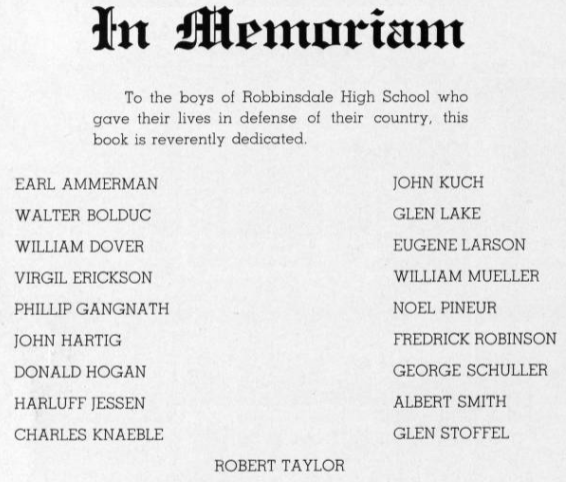
Charles attended Edison but no records of photographs of his attendance have been found to date. Interestingly, Charles’ name appears in both the “In Memoriam” Section of the 1946 Edison Wizard yearbook, and the “In Memoriam” Section of the 1946 Robbinsdale High School yearbook.
Military Service
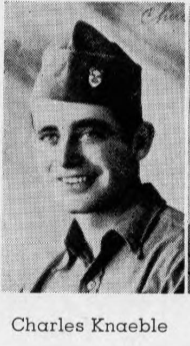

Rank: Technician 4th Grade (Sergeant)
Branch: United States Army
Unit: 67th Infantry Regiment – 2nd Armored Division
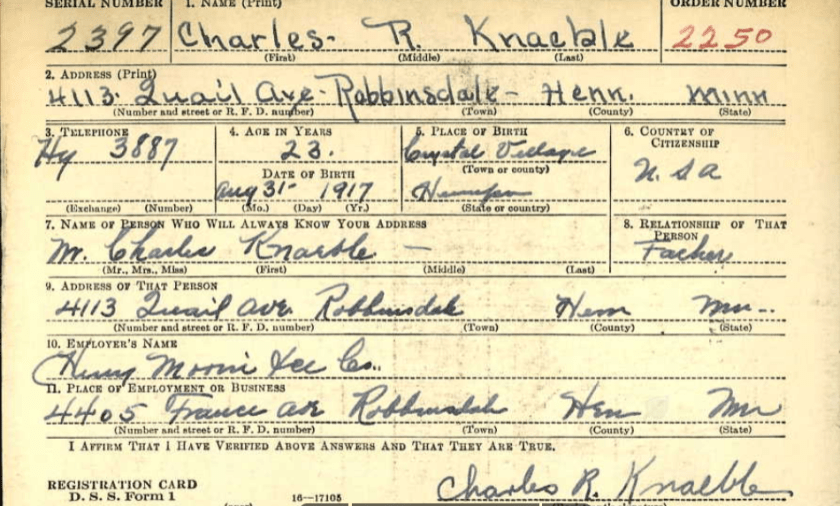
Charles enlisted army in February 1941. It is unknown if was drafted or if he joined voluntarily. It is also unknown where he attended basic training.
Assuming he was assigned to the 67th Armored Regiment after basic training, he would have spent the latter half of 1941 and the first half of 1942 training and participating in large scale military maneuvers in Louisiana and North Carolina. On 15Aug1942 his unit relocated to Fort Bragg, North Carolina for final preparations before deploying overseas. In early November the unit traveled to Fort Dix, New Jersey. On 11Dec1942 they boarded transport ships in New York City arriving in North Africa on Christmas Day.
The 67th Armored Regiment was not involved in heavy combat and spend much of its time in garrison as a reserve force to support other units and in training. It was during this time that Charles was promoted to Sergeant.

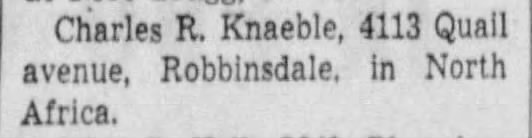
Next up for Charles and the 67th was participation in Operation Husky, the Allied invasion of Sicily. Landing on 10Jul1943 as reserve for the Western Task Force, they supported the 1st Infantry Division at the Battle of Gela, fought at Licata, Butera, Campobello, and advanced to Palermo. This was intense fighting against German and Italian forces.
After Sicily, in November 1943, the division was sent to England to train for the Allied invasion of France.
The 67th Armored Regiment did not participate in the initial D-Day invasion on 6Jun1944.
The following is from the unit After Action Report (AAR).

The 67th Armored Regiment landed on Omaha Beach on 11Jun1944. Near the beach one of the transport ships struck a sea mine causing several killed and injured and resulting in the loss of all equipment.

Once landed, they moved to an assembly area south of Lamine, France (near present day La Molay-Littry). They spent the rest of the month near the assembly area on alert for combat operations. While not in combat, the unit was still subject to Germany artillery and aerial attack. Several soldiers were wounded during this time.

On 30Jun1944, the Regiment was reorganized into 3 new battallions.
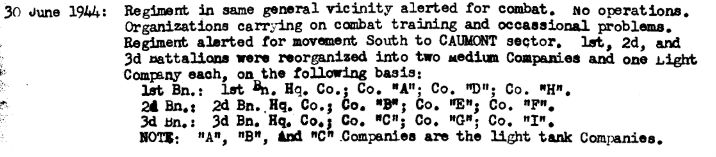
Records indicate that Charles was a member of Company H in the first battalion.
On 1July1944 Charles and the 1st Battalion moved about 18 miles to a new assembly area South Cahagnes, France. Now closer to the fighting, Charles was still not involved in active combat. Remaining in the same general location for the next couple of weeks, days were spent training. The threat of enemy fire was always present, and several men were killed or wounded during this period.

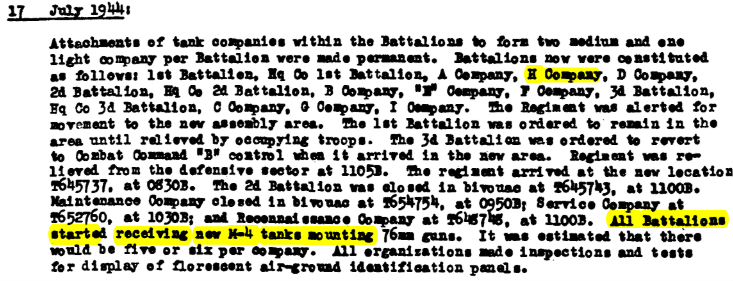
On 17Jul1944 the units started to receive new M-4 tanks with 76mm main guns better suited for battle against German tanks and anti-tank weapons.
After more training, H Company was assigned to participate in Operation Cobra. Operation Cobra was a large-scale Allied operation intended to break out of the Normandy beachhead where they had been bogged down by the Germans since D-Day. The attack was proceeded by an aerial bombing attack that included over 1,500 medium and heavy bombers.
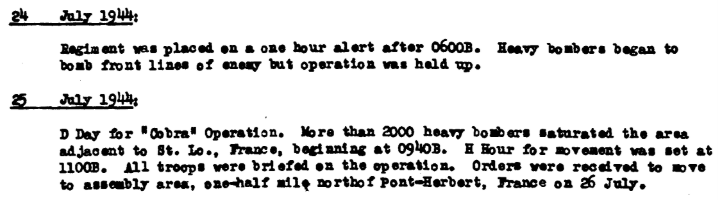
Tragically, poor visibility and targeting errors caused several planes to drop their bombs on Allied positions which resulted in an estimated 100 deaths and 500 – 600 wounded over the course of 2 days. Included in the wounded was Henry Nadeau, Edison Hero who was killed in action on 13Jan1945.
Despite the tragedy, Operation Cobra succeeded in opening a gap in the German lines which was exploited by Allied forces. While initially in the reserve for the first 2 days of the operation, on 26July1944, the division passed through lines of the 30th Infantry Division near Saint-Lô. Combat Command B (CCB), including elements of the 67th Armored Regiment, led the charge behind the 82nd Reconnaissance Battalion. They advanced rapidly south through devastated bocage terrain, reaching areas like Notre-Dame-de-Cenilly and Mesnil-Opac by July 27. Tanks rolled at high speed once beyond the hedgerows, covering significant ground.
The division split into axes: one toward Saint-Denis-le-Gast and Villebaudon, another toward Percy. They mauled retreating German columns, including two from the 2nd SS Panzer Division near La Chapelle and Roncey. U.S. tanks bombarded German armor at point-blank range, destroying much of the 2nd SS Panzer and 17th SS Panzergrenadier Division’s remaining equipment. The 2nd Armored encircled and shattered these units, preventing them from reforming a defensive line.
The 67th Armored Regiment was awarded a Presidential Unit Citation for Operation Cobra. The Presidential Unit Citation (PUC) is a prestigious military award given to units of the U.S. armed forces for extraordinary heroism in action against an armed enemy.
After almost 5 days of heavy fighting, Charles and his unit had a day of relative calm.

2Aug1944 would find Charles and Company H back in action against the Germans.
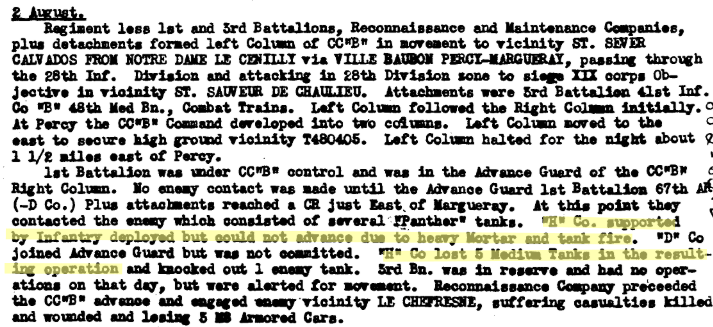
Charles was a turret gunner in one of the tanks struck by German fire. He was killed in action that day.
Charles’ body was never recovered, and he was originally listed as missing in action. After 1 year and 1 day he was declared dead via a Finding of Death (FOD).
FOD – In the absence of a recovered body, soldiers that were determined to be dead under Public Law 490. Made in cases, after at least one year from time of disappearance, when there was either conclusive proof that the person is dead or equally overwhelming evidence that the person could not have remained alive.
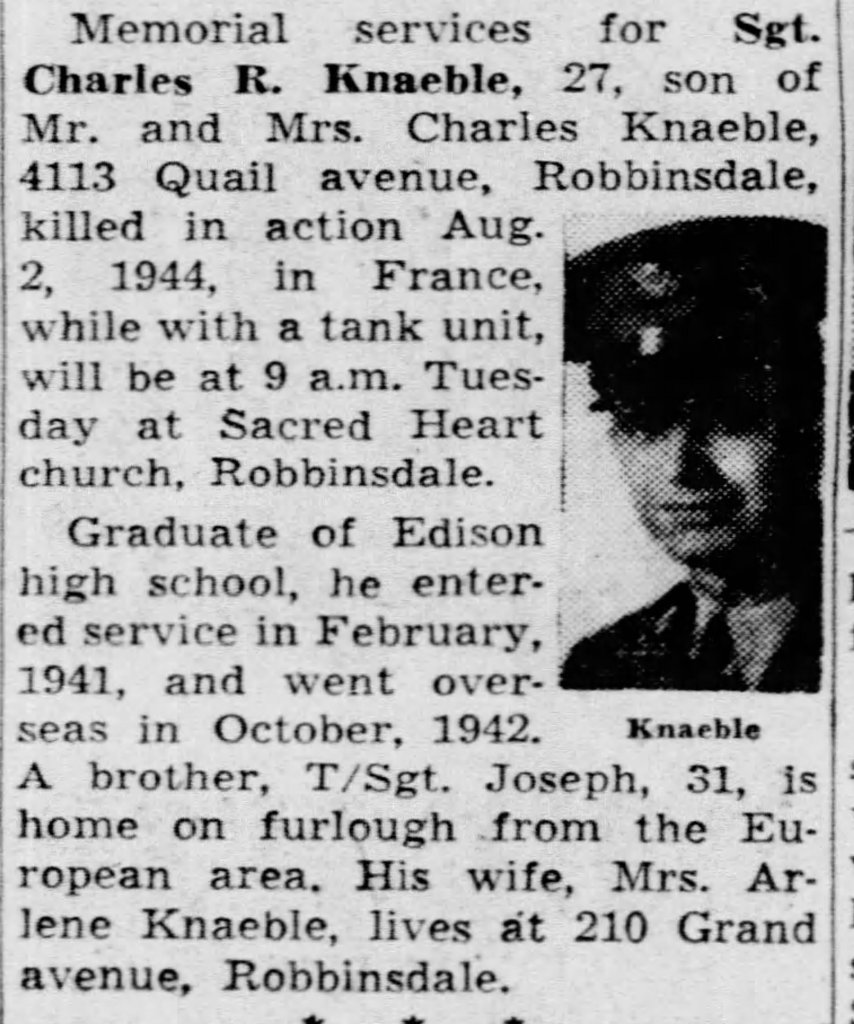
A memorial service was held for Charles in August 1945.
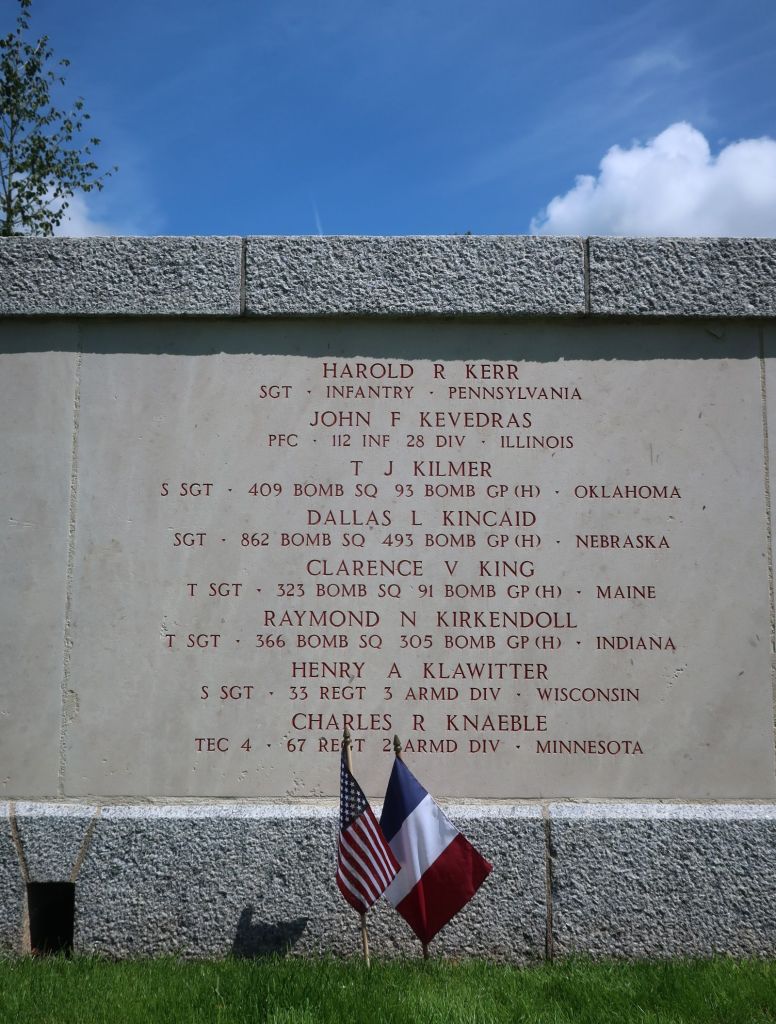
Charles’ name is 1 of 500 names engraved on a memorial wall of missing US Service members at the Brittany American Cemetery in Montjoie-Saint Martin, France. The cemetery is also the final resting place for 4,404 Americans killed in action.
Postscript
The Charles R. Knaeble VFW post in Crystal, Minnesota was (re)named in Charles’ honor. The following history is from their website.
The history of Crystal VFW #494 is a rich one that can be traced back decades.
Charles R. Knaeble, son of Mr. and Mrs. Charles Knaeble, entered military service before the start of WWII in February, 1941. When the attack on Pearl Harbor took place months later, it was the standard “duration and six months.” He was in the invasion of North Africa in 1942, the invasion of Sicily in 1943, and saw duty in England for a while, including the D-Day Invasion of France in which Charles was a tank turret gunner. In August of 1944 Charles was killed in battle at Percy, France when his tank was hit by German artillery.
Originally, the Charles Knaeble VFW Post 494 was named after the Spanish-American War veteran Hugo Hartig, during ceremonies performed on March 28th, 1931. The first Auxiliary was formed in 1931, just three months after the VFW post was formed. Because of an error, however, the Post was not registered with the State Department of VFWs. In 1947, Commander Orville Danielson registered the post as “Charles R. Knaeble Post 494” as an honor to the young man killed during WWII.
 Edison Heroes