
17Aug1923 – 26June1945
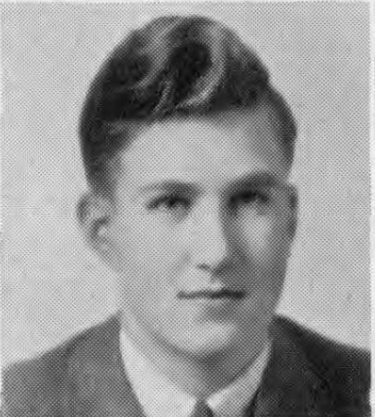

Edison Days
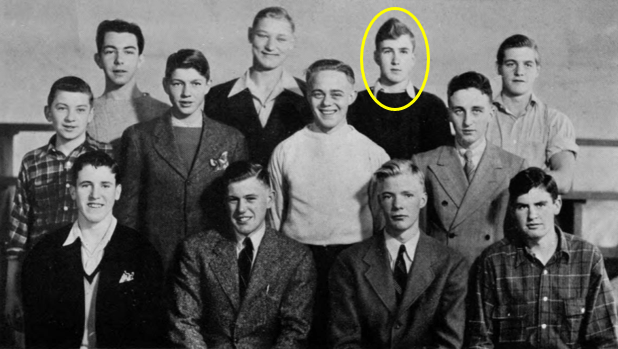
Ernest graduated with the Class of June 1941.
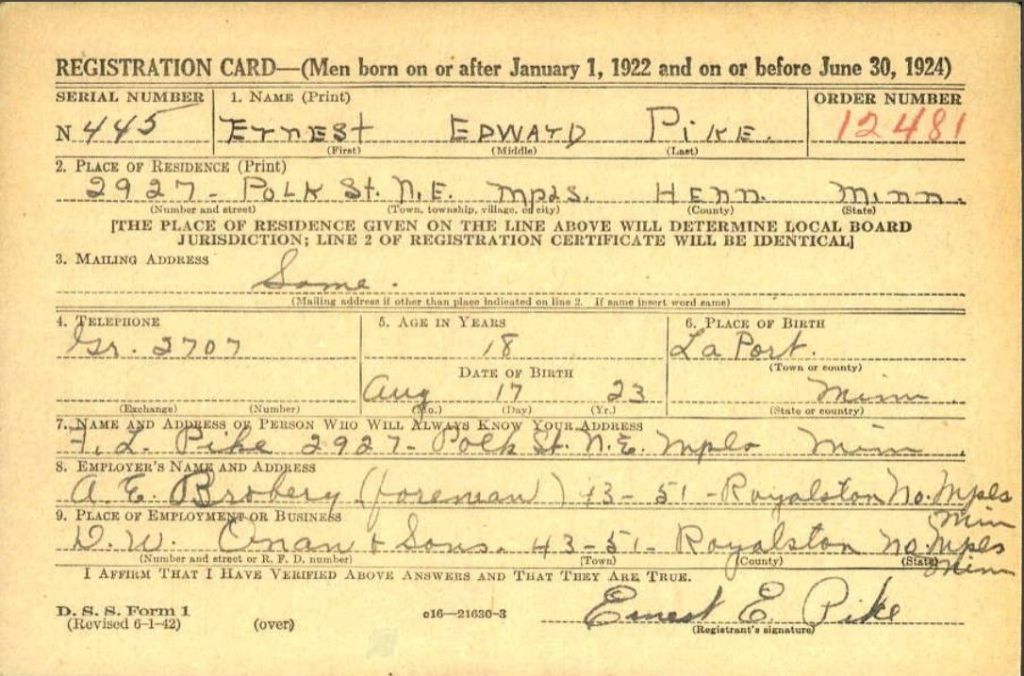
Military Service
Rate: Seaman 1st Class
Branch: United States Naval Reserve
Unit: Patrol Bombing Squadron VPB-124
The 3Dec1943 Edison Record newspaper indicated that Ernest was in the V5 program of the Naval Reserve.
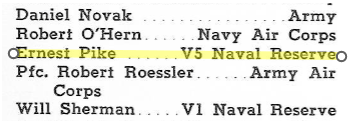
The V-5 Aviation Cadet Training Program was the U.S. Navy’s elite pipeline during World War 2 to recruit and train thousands of young men to serve as naval aviators. It is likely that Ernest washed out of pilot training and was assigned as a Seaman 1st Class in a regular Navy role.
It is unknown when Ernest joined PBY-124.
Ernest’s unit was initially established as Bombing Squadron 138 (VB-138) on 15Mar1943 at NAS Whidbey Island, Washington. It was redesignated as Patrol Bombing Squadron 138 (VPB-138) on 1Oct1944. On 15Dec1944 they were redesignated a second time, becoming Patrol Bombing Squadron 124 (VPB-124).
From late 1944 to early 1945 the unit underwent training on a newly developed radar guided bomb at NAAS Camp Kearney, California.
On 30May1945 they deployed to NAB Tinian on Tinian Island in the Northern Mariana Islands. Arriving in early June, they began long-range searches and reconnaissance missions.
Around June 16th they relocated to Yontan Field, Okinawa to conduct anti-shipping strikes, fly search/reconnaissance missions, and ground-target attacks along the China coast (including near Shanghai), Tsushima Strait, southern Korea, and Kyushu.
On 26June1944 Ernest was a crewmember on a PB4Y-2 Privateer patrol bomber that was 1 plane of a 2-plane element that embarked on a long-range search/anti-shipping patrol along the China coast in the vicinity of Shanghai. Nothing was heard from either plane after takeoff and neither plane returned to Okinawa. The following day search planes reported sighting debris of a ship and, nearby what appeared to be the wreckage of two Privateers in the water. Both crews were listed as missing in action.
It wasn’t until 29Aug1945 that the fate of the mission was revealed by POW survivors from the 2nd plane’s crew.
The following excerpt is from the official Aircraft Action Report. Ernest is not mentioned by name in the report, but it gives a sense of what happened to him.
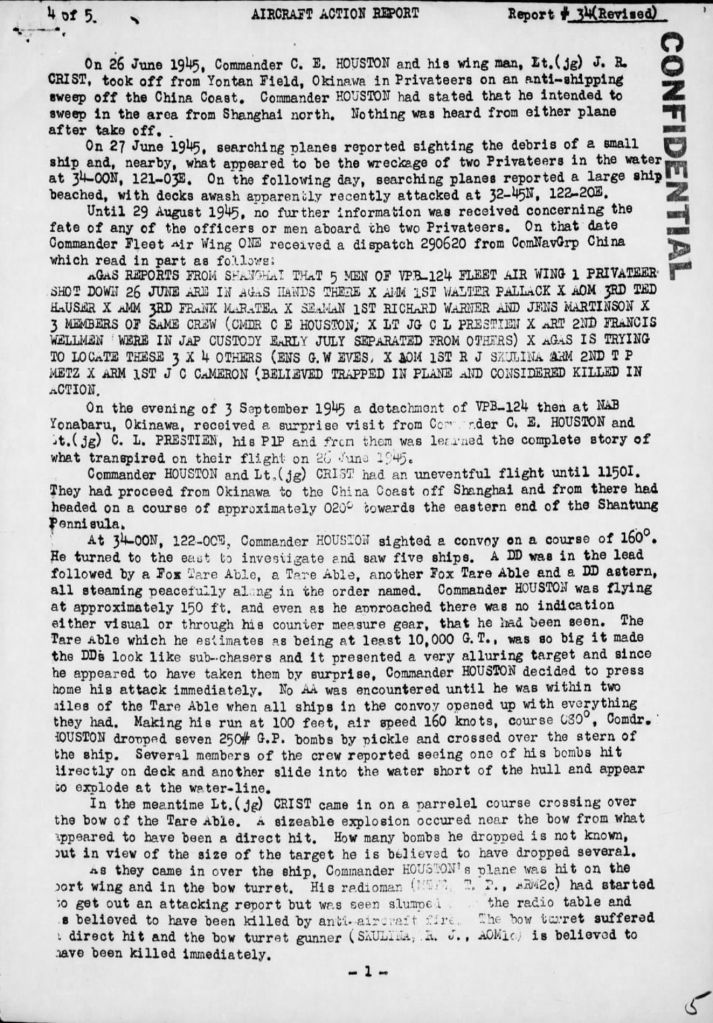
On 26 June 1945, Commander C. E. HOUSTON and his wing man, Lt.(jg) J. R. CRIST [Note: This was Ernest’s plane], took off from Yontan Field, Okinawa in Privateers on an anti-shipping sweep off the China Coast. Commander HOUSTON had stated that he intended to sweep in the area from Shanghai north. Nothing was heard from either plane after take off.
On 27 June 1945, searching planes reported sighting the debris of a small ship and, nearby, what appeared to be the wreckage of two Privateers in the water at 34-00N, 121-03E. On the following day, searching planes reported a large ship beached, with decks awash apparently recently attacked at 32-45N, 122-20E.
Until 29 August 1945, no further information was received concerning the fate of any of the officers or men aboard the two Privateers. On that date Commander Fleet Air Wing ONE received a dispatch 290620 from ComNavGrp China which read in part as follows:
AGAS REPORTS FROM SHANGHAI THAT 5 MEN OF VPB-124 FLEET AIR WING 1 PRIVATEER SHOT DOWN 26 JUNE ARE IN AGAS HANDS THERE X AMM 1ST WALTER PALLACK X AOM 3RD TED HAUSER X AMM 3RD FRANK McRATEL X SEAMAN 1ST RICHARD WARNER AND JENS MARTINSON X 3 MEMBERS OF SAME CREW (CMDR C E HOUSTON; X LT JG C L PRESTIEN X ART 2ND FRANCIS WELLMEN WERE IN JAP CUSTODY EARLY JULY SEPARATED FROM OTHERS) X AGAS IS TRYING TO LOCATE THESE 3 X 4 OTHERS (ENS G.W EVES, X AOM 1ST R J SKULINA ARM 2ND T P METZ X ARM 1ST J C CAMERON (BELIEVED TRAPPED IN PLANE AND CONSIDERED KILLED IN ACTION.
On the evening of 3 September 1945 a detachment of VPB-124 then at NAB Yonabaru, Okinawa, received a surprise visit from Commander C. E. HOUSTON and Lt.(jg) C. L. PRESTIEN, his P1P and from them was learned the complete story of what transpired on their flight on 26 June 1945.
Commander HOUSTON and Lt.(jg) CRIST had an uneventful flight until 1150I. They had proceed from Okinawa to the China Coast off Shanghai and from there had headed on a course of approximately 020° towards the eastern end of the Shantung Peninsula.
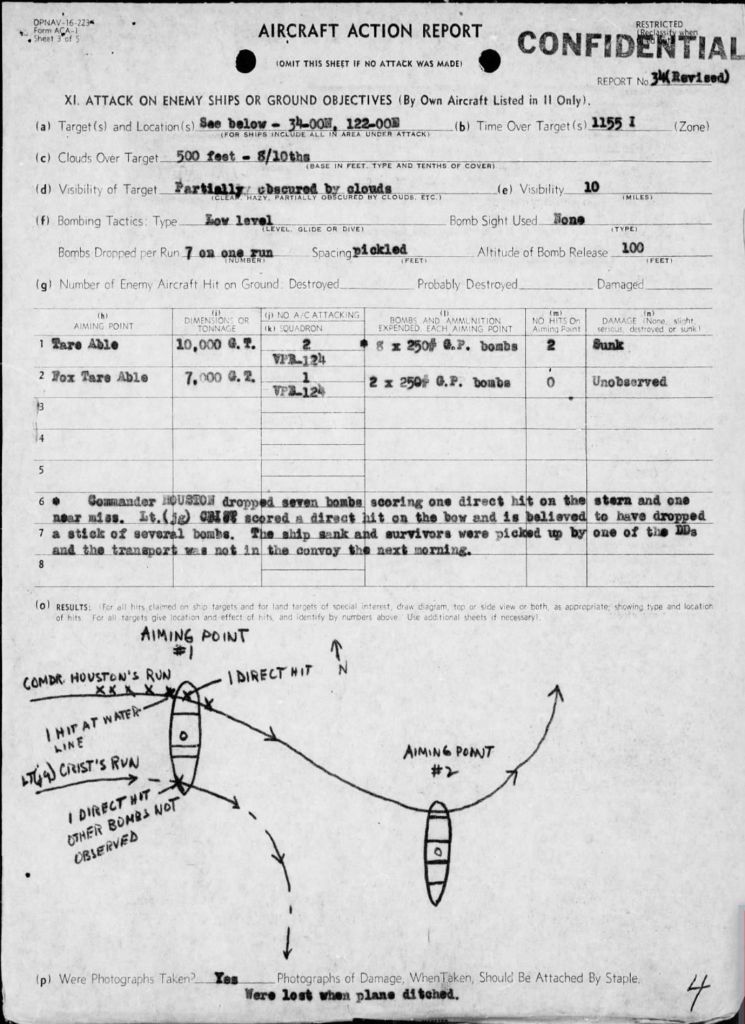
At 34-00N, 122-00E, Commander HOUSTON sighted a convoy on a course of 160°. He turned to the east to investigate and saw five ships. A DD was in the lead followed by a Fox Tare Able, a Tare Able, another Fox Tare Able and a DD astern, all steaming peacefully along in the order named. Commander HOUSTON was flying at approximately 150 ft. and even as he approached there was no indication either visual or through his counter measure gear, that he had been seen. The Tare Able which he estimates as being at least 10,000 G.T., was so big it made the DDs look like sub-chasers and it presented a very alluring target and since he appeared to have taken them by surprise, Commander HOUSTON decided to press home his attack immediately. No AA was encountered until he was within two miles of the Tare Able when all ships in the convoy opened up with everything they had. Making his run at 100 feet, air speed 160 knots, course 030°, Comdr. HOUSTON dropped seven 250# G.P. bombs by pickle and crossed over the stern of the ship. Several members of the crew reported seeing one of his bombs hit directly on deck and another slide into the water short of the hull and appear to explode at the water-line.
In the meantime Lt.(jg) CRIST came in on a parallel course crossing over the bow of the Tare Able. A sizeable explosion occurred near the bow from what appeared to have been a direct hit. How many bombs he dropped is not known, but in view of the size of the target he is believed to have dropped several.
As they came in over the ship, Commander HOUSTON’s plane was hit on the port wing and in the bow turret. His radioman (METZ, T. P., ARM2c) had started to get out an attacking report but was seen slumped over the radio table and is believed to have been killed by anti-aircraft fire. The bow turret suffered a direct hit and the bow turret gunner (SKULINA, R. J., AOM1c) is believed to have been killed immediately.
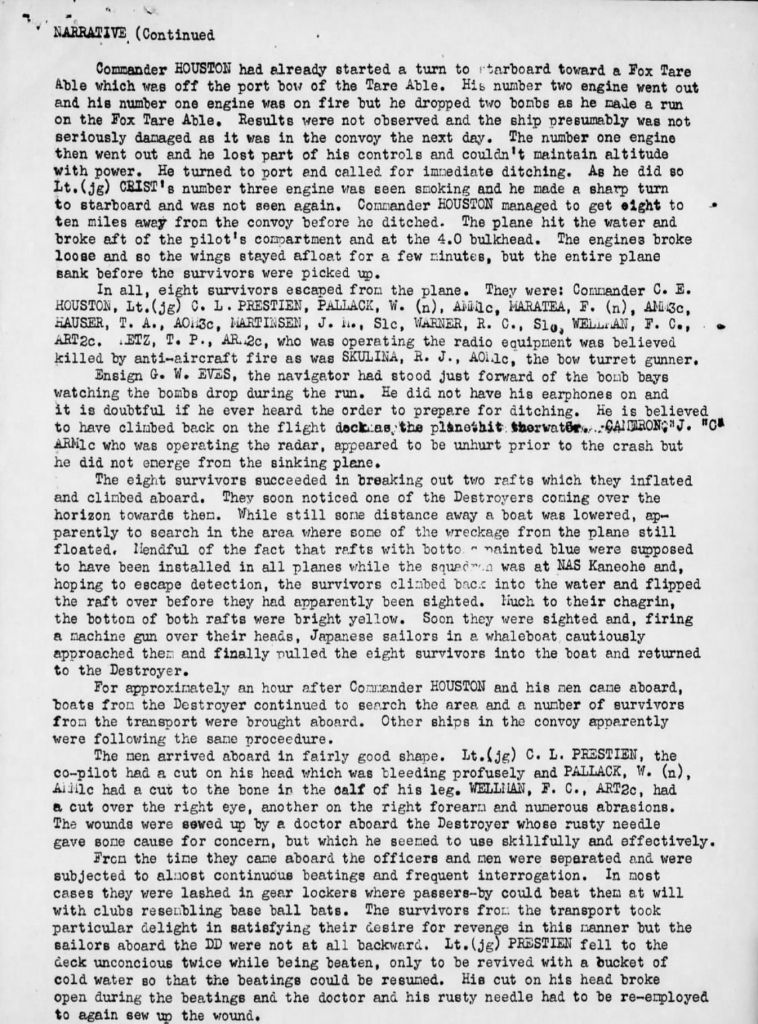
Commander HOUSTON had already started a turn to starboard toward a Fox Tare Able which was off the port bow of the Tare Able. His number two engine went out and his number one engine was on fire but he dropped two bombs as he made a run on the Fox Tare Able. Results were not observed and the ship presumably was not seriously damaged as it was in the convoy the next day. The number one engine then went out and he lost part of his controls and couldn’t maintain altitude with power. He turned to port and called for immediate ditching. As he did so Lt.(jg) CRIST’s number three engine was seen smoking and he made a sharp turn to starboard and was not seen again. Commander HOUSTON managed to get eight to ten miles away from the convoy before he ditched. The plane hit the water and broke aft of the pilot’s compartment and at the 4.0 bulkhead. The engines broke loose and so the wings stayed afloat for a few minutes, but the entire plane sank before the survivors were picked up.
In all, eight survivors escaped from the plane. They were: Commander C. E. HOUSTON, Lt.(jg) C. L. PRESTIEN, PALLACK, W. (n), AMM1c, MARATEA, F. (n), AMM3c, HAUSER, T. A., AOM3c, MARTINSEN, J. M., S1c, WARNER, R. C., S1c, WELLMAN, F. C., ART2c. METZ, T. P., ARM2c, who was operating the radio equipment was believed killed by anti-aircraft fire as was SKULINA, R. J., AOM1c, the bow turret gunner.
Ensign G. W. EVES, the navigator had stood just forward of the bomb bays watching the bombs drop during the run. He did not have his earphones on and it is doubtful if he ever heard the order to prepare for ditching. He is believed to have climbed back on the flight deck as the plane hit the water. CAMERON, J. C., ARM1c who was operating the radar, appeared to be unhurt prior to the crash but he did not emerge from the sinking plane.
The eight survivors succeeded in breaking out two rafts which they inflated and climbed aboard. They soon noticed one of the Destroyers coming over the horizon towards them. While still some distance away a boat was lowered, apparently to search in the area where some of the wreckage from the plane still floated. Mindful of the fact that rafts with bottoms painted blue were supposed to have been installed in all planes while the squadron was at NAS Kaneohe and, hoping to escape detection, the survivors climbed back into the water and flipped the raft over before they had apparently been sighted. Much to their chagrin, the bottom of both rafts were bright yellow. Soon they were sighted and, firing a machine gun over their heads, Japanese sailors in a whaleboat cautiously approached them and finally pulled the eight survivors into the boat and returned to the Destroyer.
For approximately an hour after Commander HOUSTON and his men came aboard, boats from the Destroyer continued to search the area and a number of survivors from the transport were brought aboard. Other ships in the convoy apparently were following the same procedure.
The men arrived aboard in fairly good shape. Lt.(jg) C. L. PRESTIEN, the co-pilot had a cut on his head which was bleeding profusely and PALLACK, W. (n), AMM1c had a cut to the bone in the calf of his leg. WELLMAN, F. C., ART2c, had a cut over the right eye, another on the right forearm and numerous abrasions. The wounds were sewed up by a doctor aboard the Destroyer whose rusty needle gave some cause for concern, but which he seemed to use skillfully and effectively.
From the time they came aboard the officers and men were separated and were subjected to almost continuous beatings and frequent interrogation. In most cases they were lashed in gear lockers where passers-by could beat them at will with clubs resembling baseball bats. The survivors from the transport took particular delight in satisfying their desire for revenge in this manner but the sailors aboard the DD were not at all backward. Lt.(jg) PRESTIEN fell to the deck unconscious twice while being beaten, only to be revived with a bucket of cold water so that the beatings could be resumed. His cut on his head broke open during the beatings and the doctor and his rusty needle had to be re-employed to again sew up the wound.
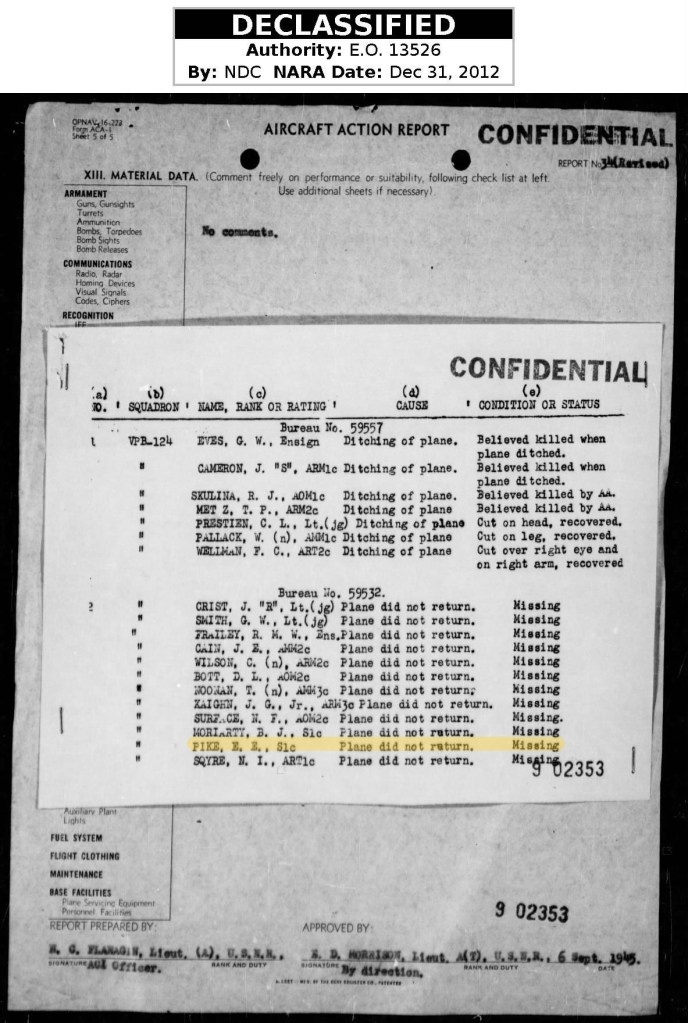
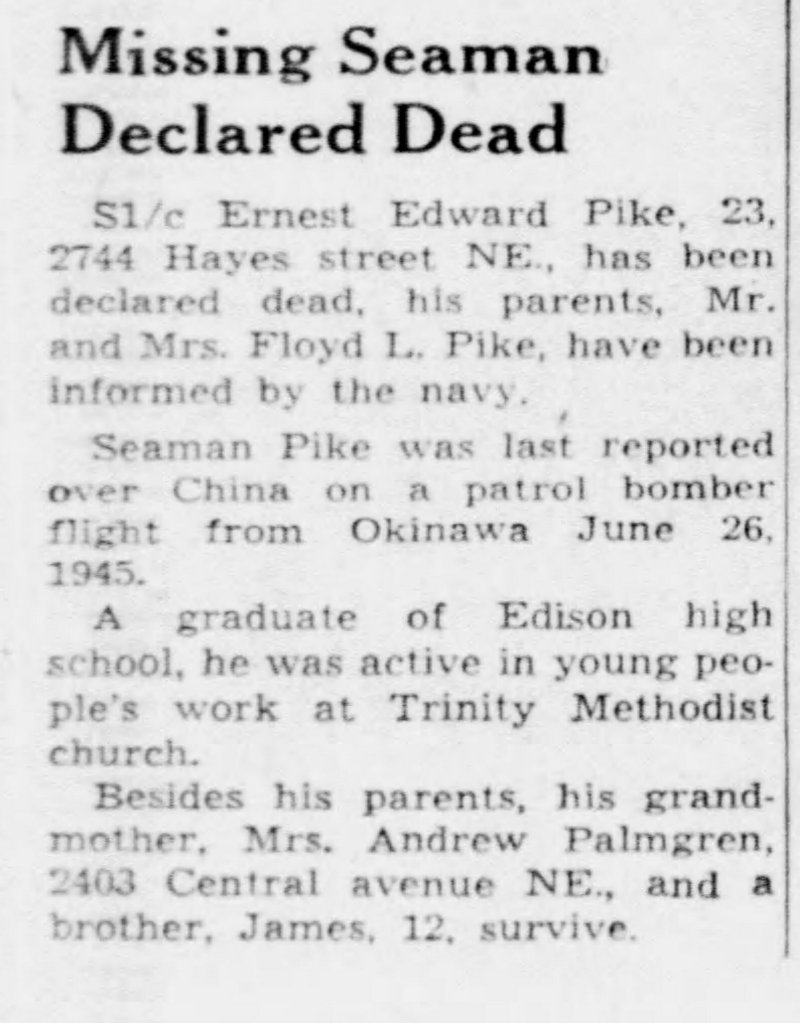
Ernest and the other 11 men on his plane were never found.
On 27Jun1946, 1 year and 1 day after he was lost at sea, Ernest was declared dead.
Ernest’s is 1 of 36,286 names inscribed on the Tablets of the Missing at the Manila American Cemetery and Memorial in Manila, The Philippines.

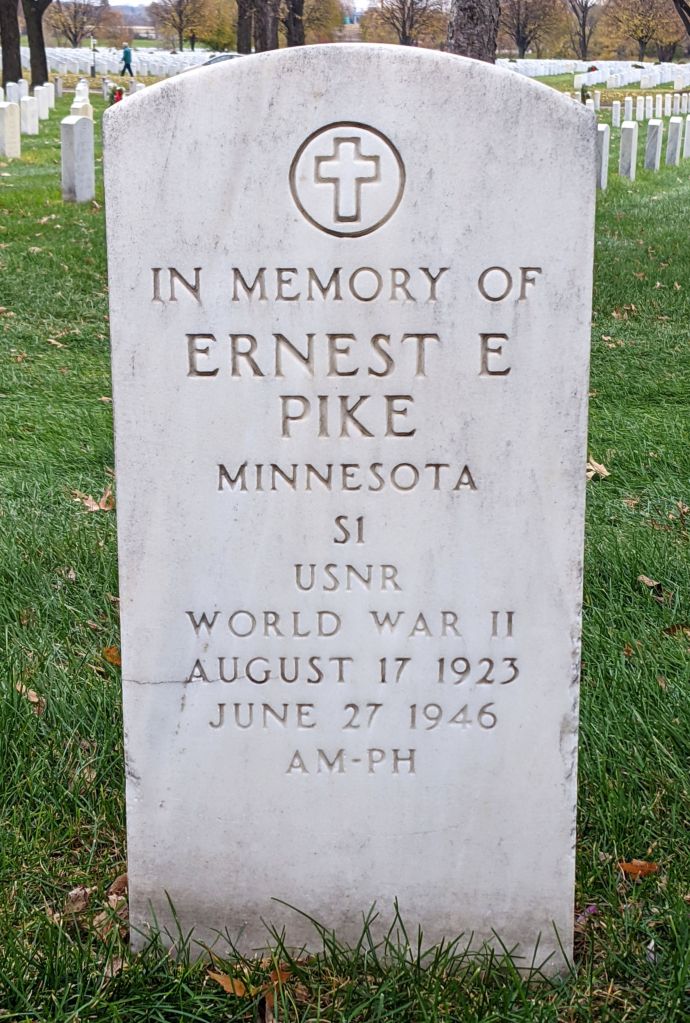
Additionally, a Cenotaph (memorial headstone) was erected in his memory at Fort Snelling National Cemetery in Minneapolis, Minnesota.
 Edison Heroes