
27Aug1912 – 17Jun1945
Edison Days
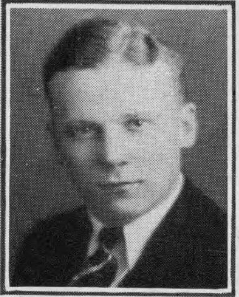
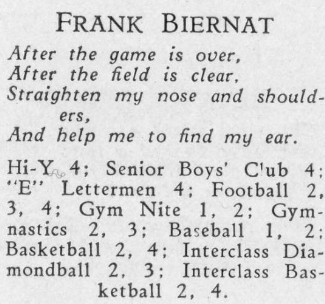
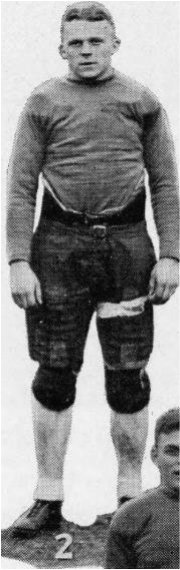
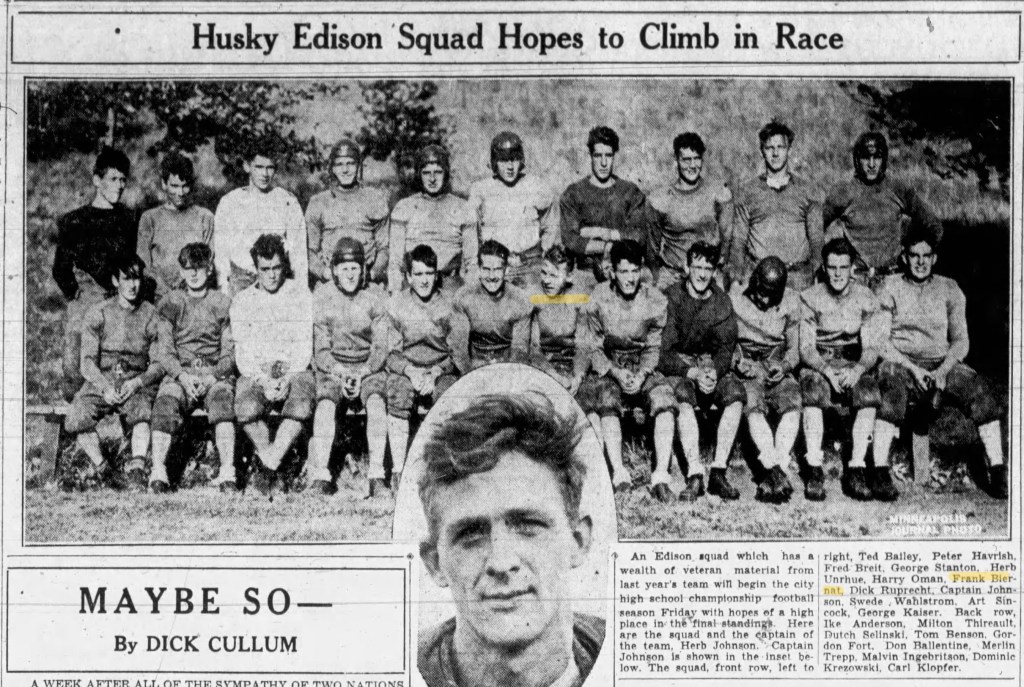
Frank graduated with Class of June 1931. He was an excellent athlete who played football, basketball, baseball, and he participated in gymnastics. He was a 2-time letter winner in football.
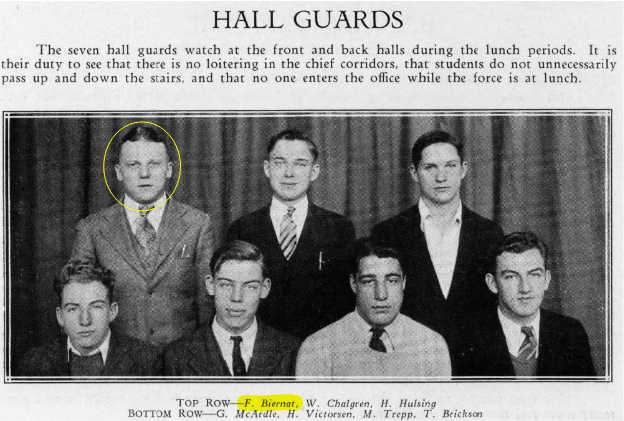
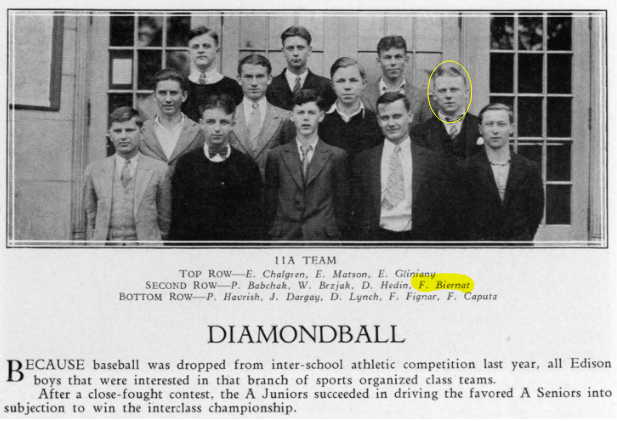
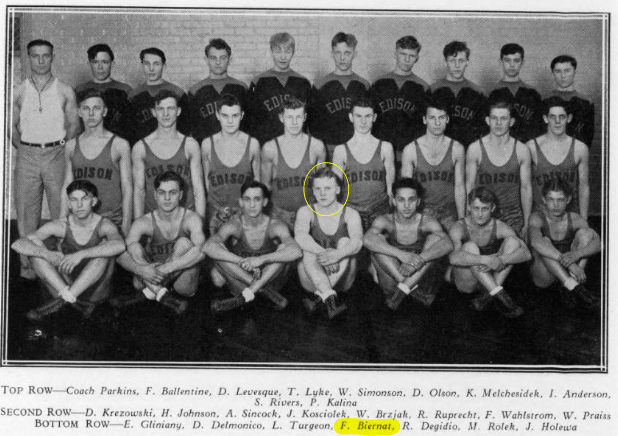
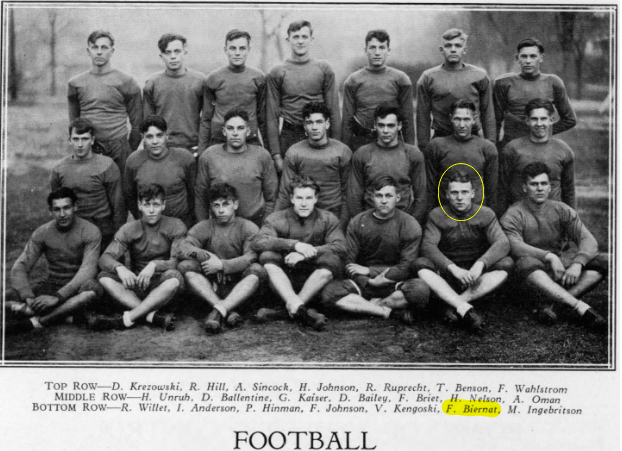


After graduation Frank attended the University of Minnesota, and from 1932 to 1936 he attended the Foreign Service School at Georgetown University in Washington, D.C.
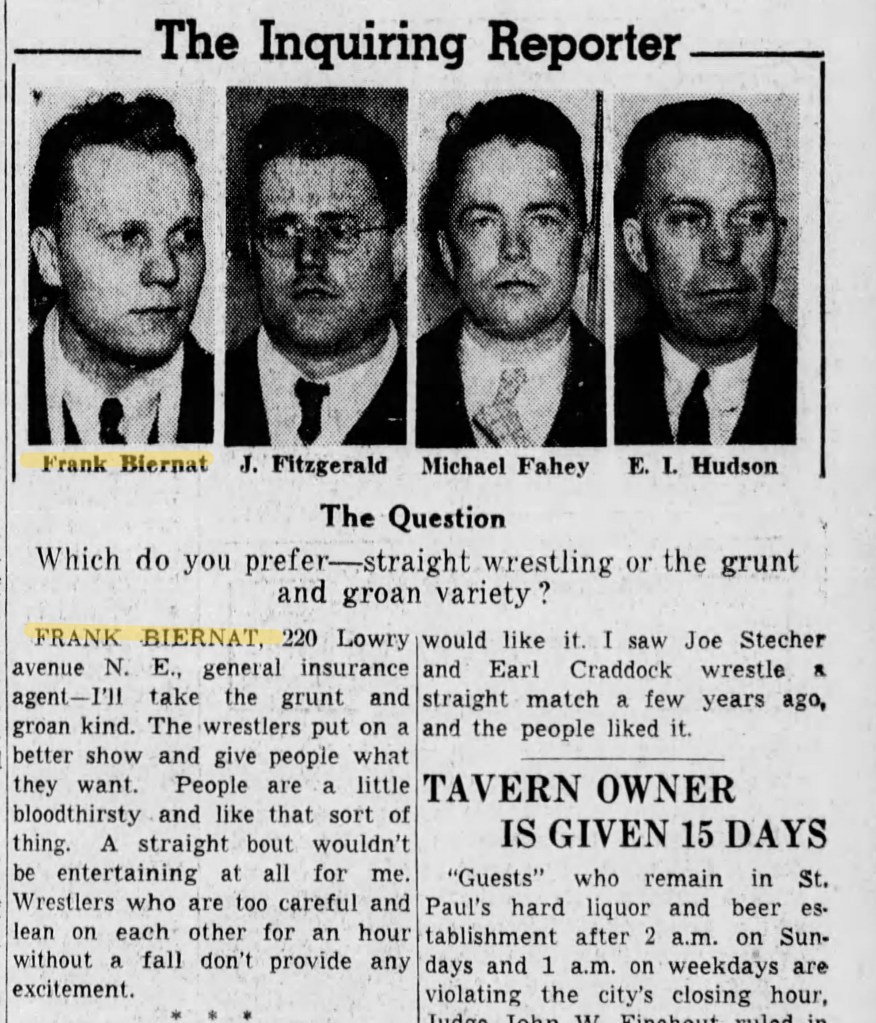
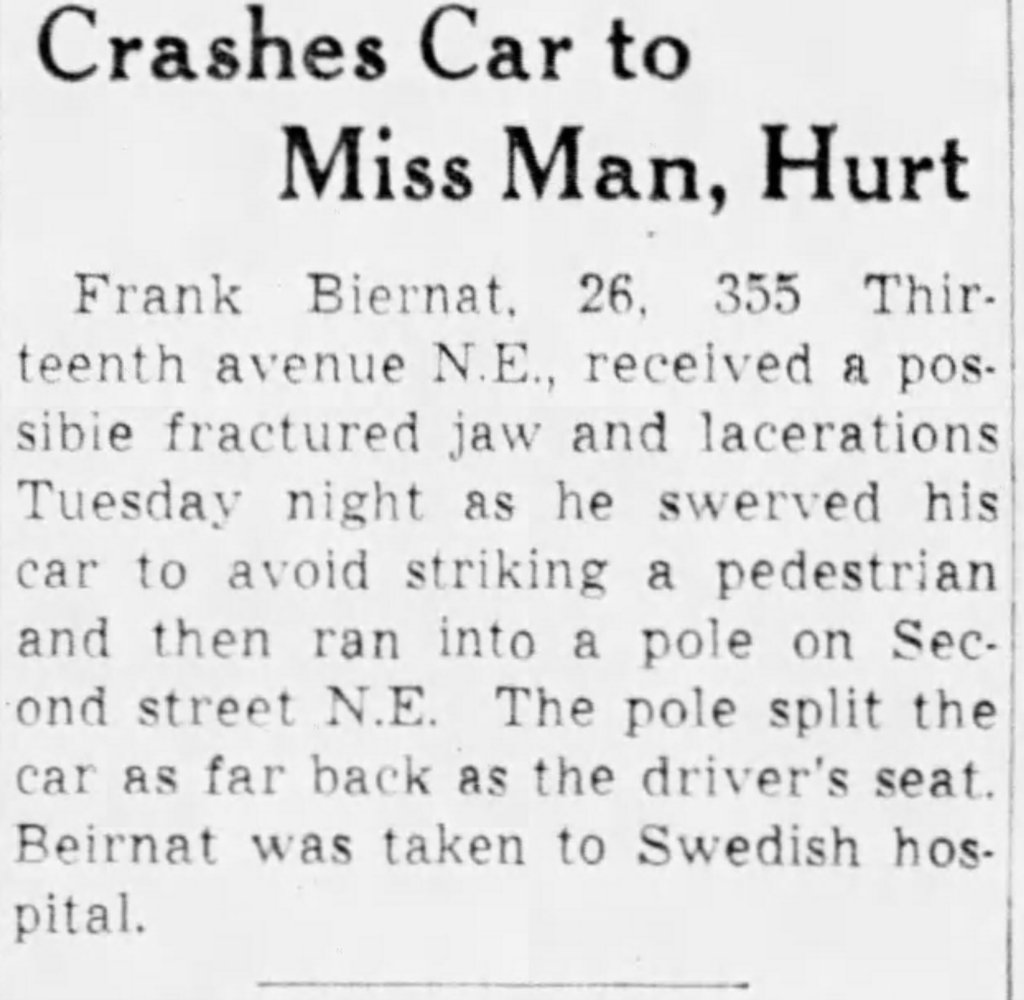
After returning to Minneapolis, Frank appeared in the Minneapolis papers twice in 1937.
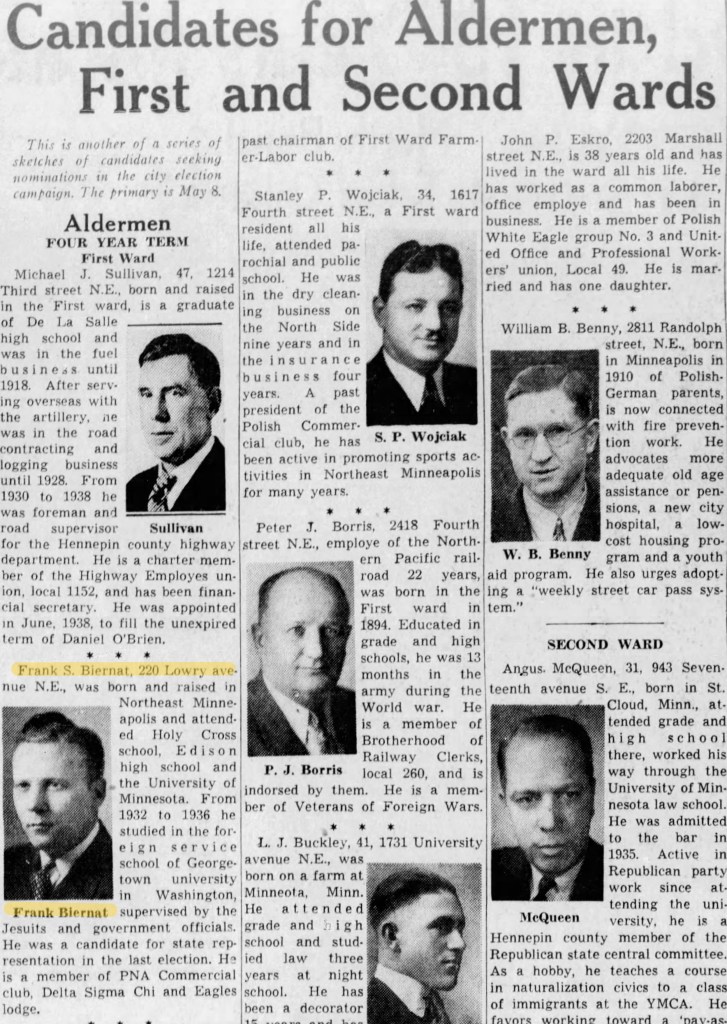
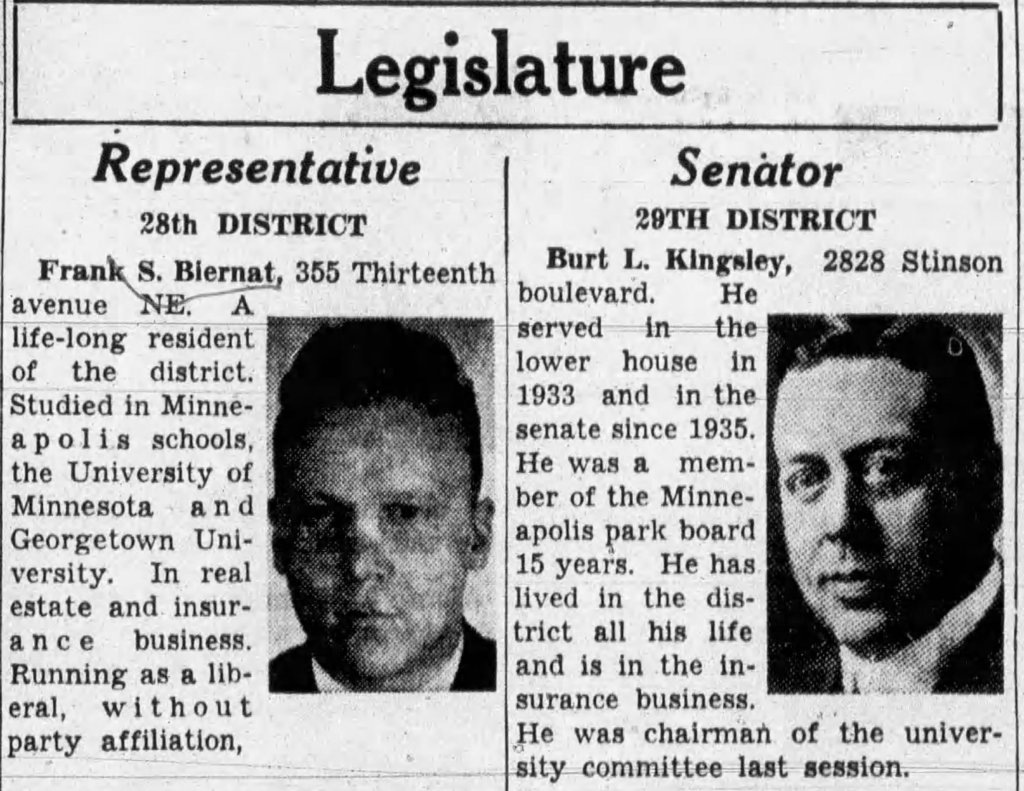
In 1938 Frank was unsuccessful in his attempts for elected office. First for city Alderman, and second for State Representative.
Military Service


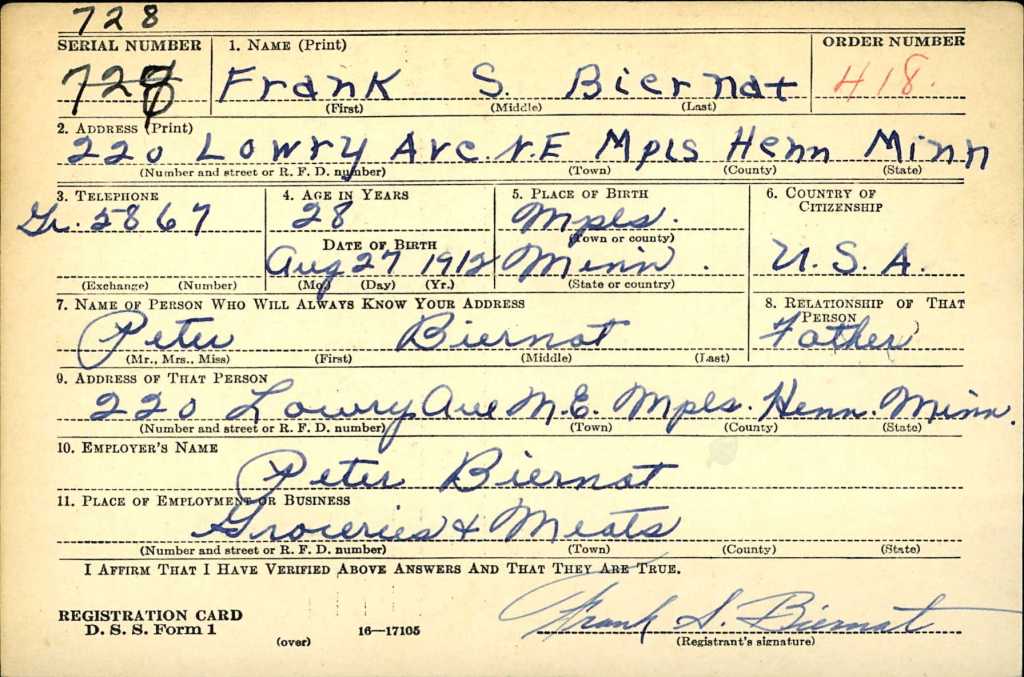
Rank: 1st Sargeant
Branch: United States Army
Unit: 20th Infantry Regiment – 6th Infantry Division
Frank’s path to the Army is unknown. On 11June1943 the 11th Infantry Regiment landed at Maffin Bay in New Guinea. 3 days later they relieved another unit at Lone Tree Hill. After 10 days of hard fighting, Lone Tree Hill was in American control.
Control of Lone Tree Hill allowed the Allies to use Maffin Bay as a major staging base for the subsequent landings at Leyte and Luzon in the Philippines.
On 9Jan1945 Frank and the 20th Infantry Regiment landed unopposed at Blue Beach in Lingayen Gulf on Luzon. It was the largest amphibious landing of the Pacific war. Japanese bombardment soon commenced, however, and the 6th Infantry Division’s battle for Luzon would continue unabated for the next 219 days.
Before them were 250,000 well equipped and well-fed Japanese troops, and the strongest collection of armor in the entire Pacific Theater. The Japanese had three years to make the position impregnable.
In the battle of the Cabaruan Hills which followed, the Japanese had pledged a suicidal defense of the area. The 20th Infantry Regiment and the 1st Infantry Regiment with the support of a tank detachment, faced an enemy well entrenched and hidden in ground honeycombed with foxholes, prepared earthworks and pillboxes making observation of the enemy impossible and forcing troops to proceed with the utmost caution, probing weaknesses in Japanese defenses. Casualties suffered included 198 wounded and 81 dead. For the Japanese, 1,432 were killed and 7 were captured. The battle was concluded January 30, 1945.
In the next engagement, at the town of Munoz, the 1st, 20th and 63rd regiments converged with tank and artillery support where the largest concentration of Japanese armor was to be encountered in the war. On January 30th Company K of the 20th Infantry came under such intense fire that a smoke screen had to be laid down to effect their retreat. The town of Munoz offered excellent defensive positions for the Japanese and their well fortified and entrenched defenses which included 56 tanks. It quickly became obvious that this small town was going to take the entire Division, plus support from American tanks and heavy artillery. Over the next five days, intense fighting continued as the forces of the 1st and 63rd Infantry cut off the Japanese escape route.
During the night of February 5th the enemy engaged in a counter-offensive using their entrenched tanks without success. On the night of the 6th they attempted to escape through what they appeared to believe was the path of least resistance, but which had been heavily fortified with American tanks, tank destroyers and Bazookas. There at 0330 hours they encountered the roadblock set up by the 63rd Regimental Combat Team, which made quick work of two tanks with 37mm cannon and .50-caliber machine gun fire. Further down the road the 53rd and 80th Artillery Battalions lowered their muzzles and fired at point blank range against the advancing armor column. The battle won with losses of 97 dead and 303 wounded of which 54 were from the 20th Infantry Regiment alone, the “Sightseers” moved on to their new assignment. Losses for the Japanese were 1,935 killed. There were no prisoners.
In the next engagement, while the 37th Infantry Division was fighting for Manila, the 20th Infantry Regiment with the 63rd Regimental Combat Team was ordered to drive to the East Coast of Luzon to effectively cut the forces of General Yamashita in half. Medic “Jack” Murphy recalled the liberation of the Cabanatuan Prison Camp by the Sixth Army Rangers a few days before, but nothing prepared him for what he saw when the 20th Infantry actually marched in to see the remnants of the shacks of the “death” camp where he knew more than 2,700 young American corpses lay naked and rotting “in a shallow and water soaked mass grave.” Murphy marched on. At the same time, the 1st Infantry Regiment began a Western drive across the Bataan Peninsula to cut off the enemy there. The 1st Infantry Regiment were the first troops to enter the central Bataan Peninsula since the infamous Bataan Death March. These missions accomplished, and Manila taken by the 37th Infantry Division, the Division’s regiments reunited to converge of the high ground of the Shimbu Line East of Manila where 14,000 Japanese troops were, again well fortified, entrenched in caves and earthen-pillboxes and prepared and determined to fight to the death.
The Shimbu Line proved to be the harshest campaign yet for the weary soldiers of the 6th Division. Fought from February 20th through April 30th of 1945, the battles waged there proved particularly harsh and pitiless. Fighting was round the clock and every night proved the power of the cult of bushido as the Japanese launched banzai attacks. Main points in the strong Japanese defensive line were Mt. Oro, Mt. Pacawagan , Mt Mataba and Mt. Baytangan, all rising over 1,000 feet, heavily wooded and bristling with concealed weaponry. To many from the 6th Division, the Shimbu Line reminded them of the fighting at Lone Tree Hill. As the men of the 6th were soon to discover, it was “one damn hill after another” as the brutal fighting continued where every offensive was met with a counter offensive and a night attack. Caves were sealed with demolitions and bazooka fire. Flamethrowers and Napalm attacks from P-38s became commonplace as the Japanese were literally burned out of their caves and fortifications or buried alive. Here, over 6,500 were killed. For the 6th Division 107 were killed and 569 wounded. This campaign alone, represented 112 days of uninterrupted combat before success was achieved.
At some point during this period, Frank would earn the Bronze Star Medal.
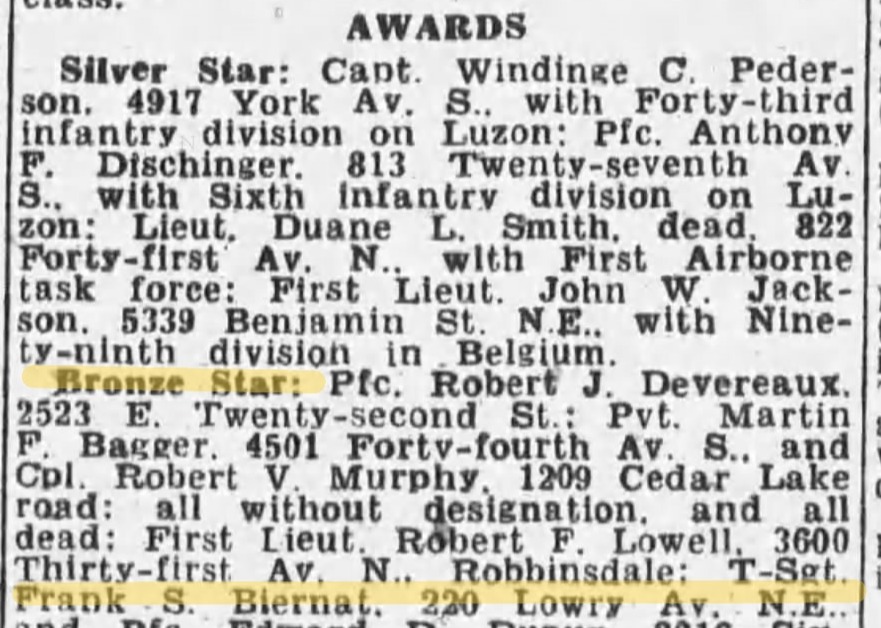
The Bronze Star Medal (BSM) is a United States Armed Forces decoration awarded for heroic achievement, heroic service, meritorious achievement, or meritorious service in a combat zone. It is the fourth highest-ranking award that a service member can receive in the U.S. military, recognizing those who have performed a heroic or meritorious deed in armed conflict. The medal is awarded to any person who, after December 6, 1941, while serving in any capacity with the Armed Forces of the United States, distinguishes themselves by such achievement or service.
During May through June 12 of 1945, the 6th Division was assigned to combat and mopping up enemy in the Central Luzon area, including securing the remainder of Bataan by the 1st and 63rd Regiments. Casualties there were lighter, with 17 killed and 106 wounded. The Japanese lost 1,320 killed. For the first time there were prisoners; 269 were captured.
From Central Luzon to the end of the war, until August 15, 1945, the 6th Division was assigned to take the last stronghold of General Yamashita in the Cordellera Mountains and Cagayan Valley of Northern Luzon in an area of deep ravines and thick Jungle along what was known as Highway 4. The Highway was exceedingly poor and cover for the enemy was equally as substantial that found against the Shimbu Line. Here, with great assistance from Philippine guerilla forces, the 6th Division engaged in what would become their last battle of the war against an enemy still determined, in many cases, to fight to the death.
Frank was killed in action on 17Jun1945 when he was struck by shrapnel from a Japanese grenade.
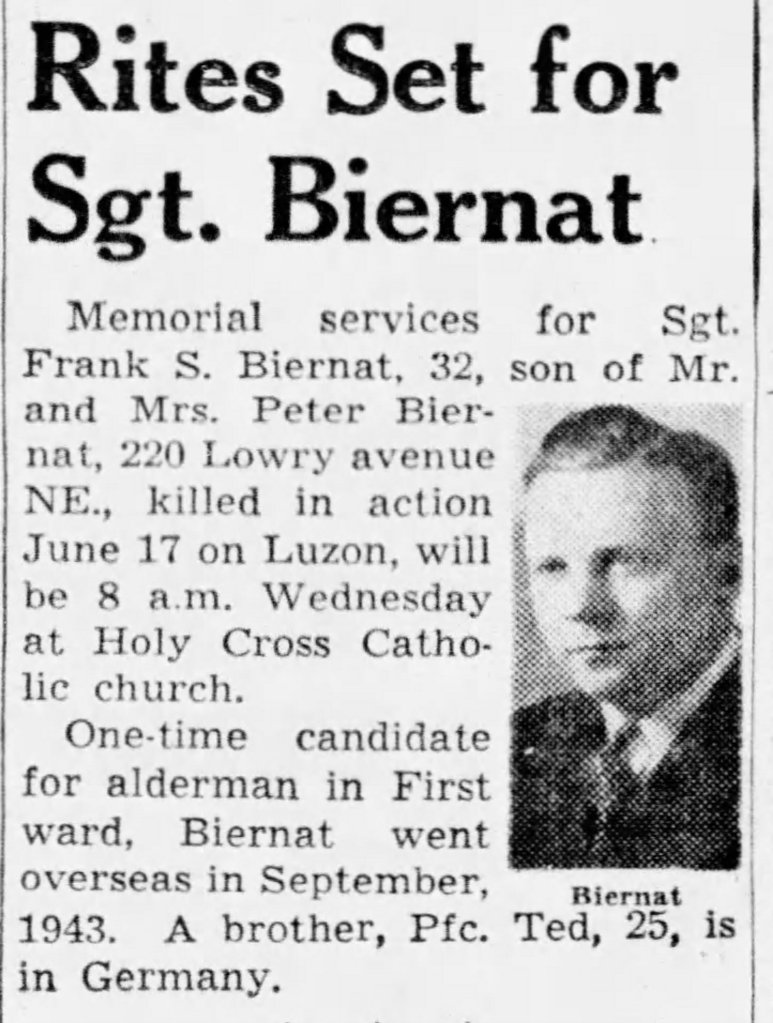
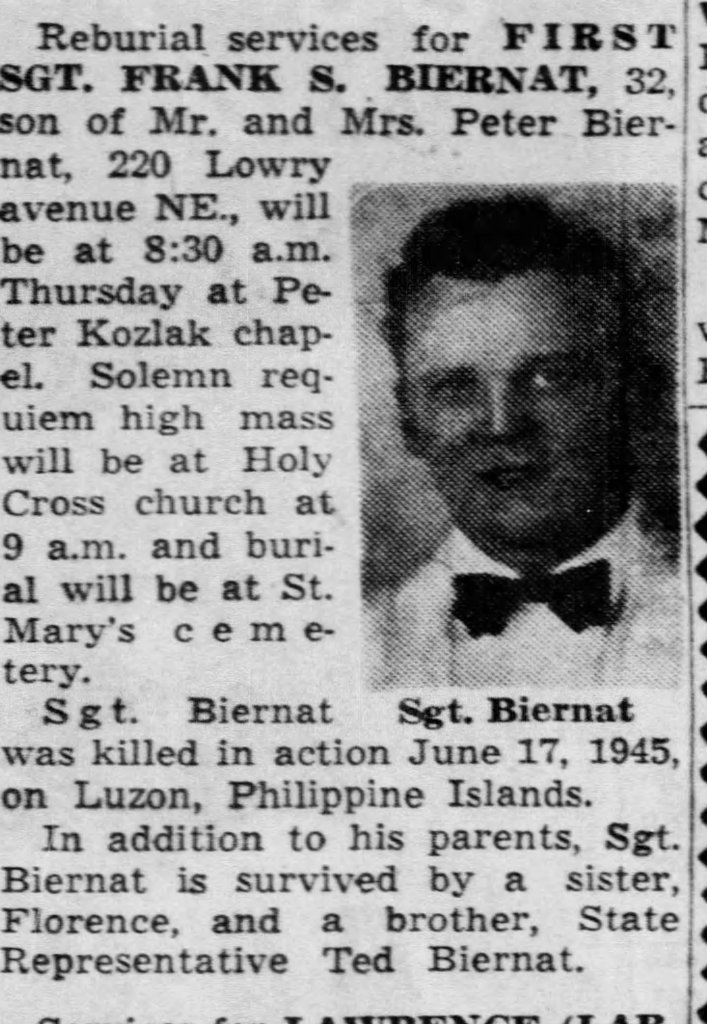
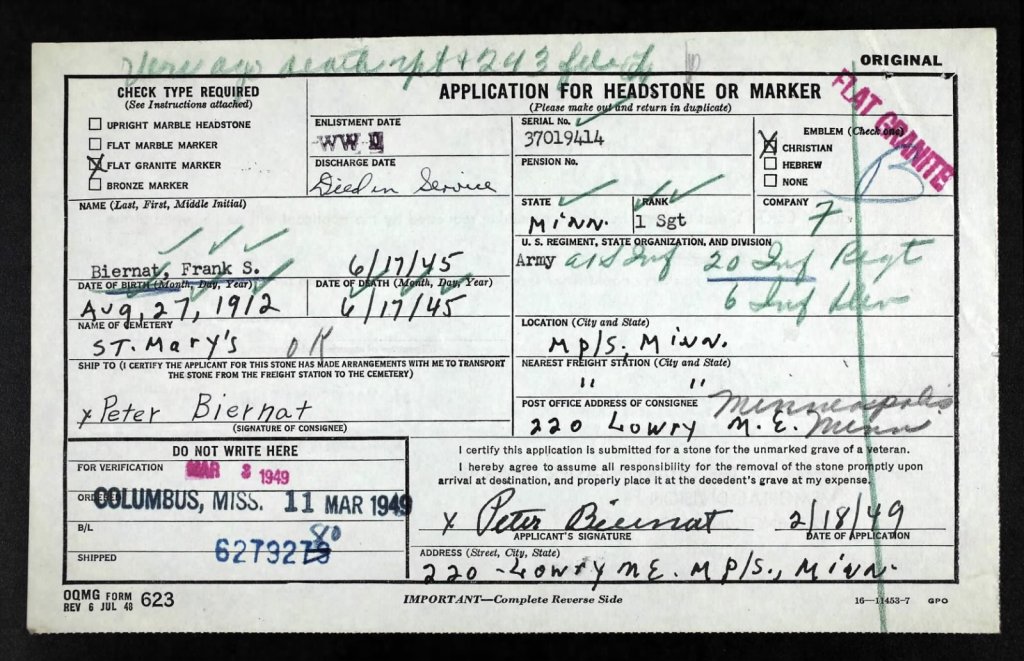
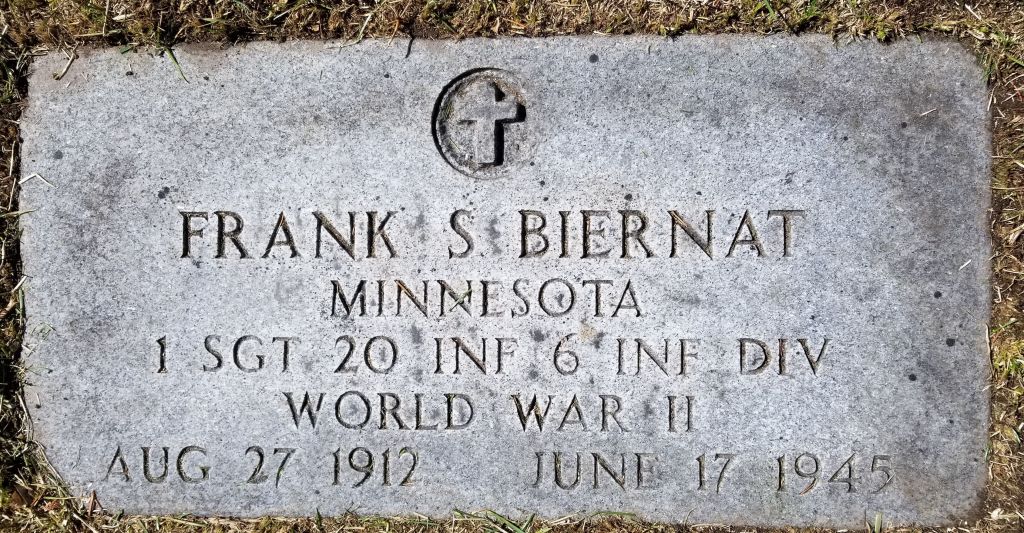
Frank was buried in a temporary cemetery on Luzon. In 1949 his remains were returned to Minnesota for reburial at St. Mary’s Cemetery in Minneapolis.
 Edison Heroes