
19Sep1946 – 11May1968
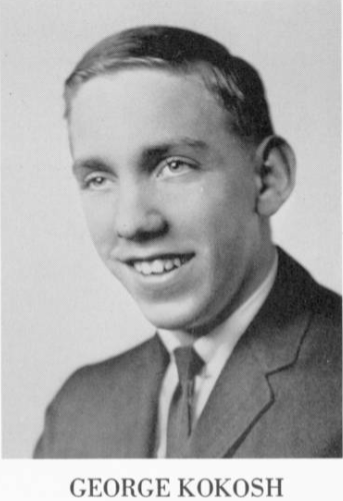
Thank you to George’s siblings Carol, Jim, Lauren, and Jeanne for providing family photos.
Edison Days
George, “Skip” to his family and friends, graduated with the Class of 1964. He participated in track, tennis, band, and the 1964 production of the play “Our Town”. Outside of school he was a Boy Scout, who attained the rank of Eagle Scout.
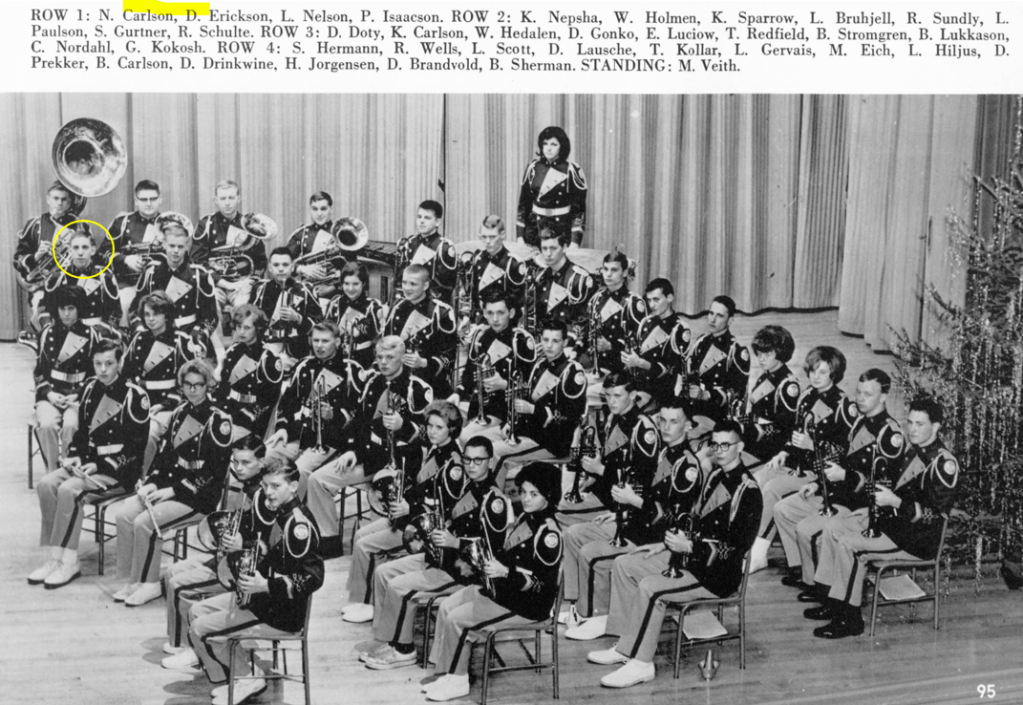
After graduation, Skip attended the University of Minnesota for 2 years. In 1966 he became involved with the Minneapolis Aquatennial celebration and even drove the convertible for the Queen of Lakes in the Aquatennial Parade. The Queen was fellow 1964 classmate, Linda Kleinert.
Military Service
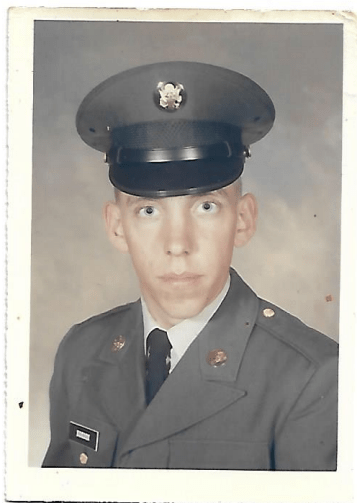
Rank: Private First Class
Branch: United States Army
Unit: Company D – 4th Battalion – 9th Infantry Regiment – 25th Infantry Division.
Skip was drafted in 1967 and entered service on October 10th of that year. He took basic training at Fort Cambell, Kentucky and advanced training at Fort Polk, Louisiana. After which he returned home to Minnesota on a brief furlough.

After his furlough ended, Skip shipped out to Vietnam, arriving in country on 19Mar1968. It is likely that Skip was assigned as a replacement soldier with the 4th Battalion – 9th Infantry Regiment (“the Manchus”) as they were enjoying a period of light activity to refit and receive new troops after being in near continuous combat since December 1967.
For most of April, Skip and the Manchus were training and conducting 1-day missions around Tay Ninh.
On 3May1968, the Manchus joined Task Force Daems for Operation Toan Thank I. The Task Force was sent to attack and disrupt the enemy and hinder their ability to attack Saigon. For the next 9 days the battalion was involved in combat with the enemy on a daily basis.
The following excerpt is from a unit history compiled by men from Skip’s sister company in the battalion.
Day Nine, 11-May-1968
It’s a bright sunny morning. Days before, contact with the enemy was brief and scatter throughout the Battalion’s area of operation (AO). Our AO was flat open grassland interspersed with patches of woodlands, thickets, narrowly brushed tree lines, rice paddy fields, swamps and semi-drier areas. The battalion had been conducting company-size, and battalion-size, reconnaissance in force sweeps from a temporary base camp. Shortly after sunrise, Alpha and Delta Company left its night operating position (NOP) for their day’s mission: a two-company reconnaissance in force patrol. Less than two hours into it, Delta was pinned down by VC (Viet Cong) gunfire.
Alpha Company—three platoons commanded by CPT Elcie Adams, who had recently replaced CPT Jerry Weigand—was approximately 100 yards away on lower ground. It was moving in two staggered columns, and maneuvered around to the left of Delta to flank the enemy’s location. Along the way, Alpha’s 3rd Platoon went into a hedgerow and started receiving gunfire. Alpha Company now had a fight of its own. Both of the companies had walked into a box of bunkers.
After the platoons regrouped from the VC’s attack, the Manchu-men tried to knock out the VC positions with LAWs that didn’t work. A powerful weapon, the LAW was designed as a one-time use, one-gunner rocket launcher for uses as a light anti-tank weapon. However, in Vietnam it was used to destroy bunkers or for attacking an entrenched enemy. Several guys were online firing the shoulder-held LAWs, across a deep pool of water, at the VC’s concealed low-lying fighting positions. They were trying to hit the sides of the embankment, hoping to get a direct hit on a bunker or fighting hole. As the roar of the 66mm rocket warheads hit the water’s surface and the thicketed areas—and striking no hard surfaces—the high-explosive rockets didn’t explode. The rockets caused no damage whatsoever, other than a splash in the water or an unheard rustle through the brush. At least six were fired—all coming up short with the same result: no explosion. SGT Gin was pissed off about that and almost got up and walked off the battlefield because he was disgusted with the two LAWs he had fired. It’s doubtful the LAWs were faulty; maybe the rocket projectiles were equipped with a distance mechanism for safety reasons, which prevented them from exploding within a certain range upon impact.
Eventually, all “Bloopers” (M79 grenade launchers, also referred to as “Thumpers”) were called forward to bring fire on the enemy’s location. The M79 grenadiers were lobbing in high-explosive 40mm grenade rounds when the Light Fire Team (two gunships) arrived on station and started their air attack on the wood-lined embankments. The gunship attacks were at close quarters to Alpha Company’s men—firing off their rockets, mini-guns and M60 door guns. The attacks were coordinated, so that one gunship covered the other as it finished its gun run and turned outbound from its target. Then the other gunship began its concentrated attack on the bunkered wood lines—cutting a path of destruction through the trees and the undergrowth, and disrupting the VC’s attack on the men in the field.
After the gunships broke off their attack and left the area, in came an artillery strike. A massive barrage of artillery pounded the same brushed, tree-lined embankments. The artillery rounds penetrated deeply into the ground, and the delayed explosions up-rooted trees and underbrush, tossing aside dirt, branches and debris mixed in with muddy water in every direction. The pounding cleared the concealment of the hidden bunkers and fighting holes, inflicting a heavy toll upon the enemy.
Picking up from where the artillery left off, the gunships returned to finish off any VC in the target area. After the second gunship run was over, the Manchu-men cautiously approached the area of attack to assess the damages and to eliminate any remaining resistance.
Having secured the area against a counterattack by the VC, it was policed for weapons, gear and other war materiel, and the injured evacuated to Cu Chi. To the right of Alpha Company’s position there was a roll of trees and undergrowth—a strip of woodlands—barely obscuring several large fields on the other side. Delta Company was in the closest field, and possibly a second company: Charlie Company who had come to the scene after Delta and Alpha’s fight was over. They had moved into the area to link-up, as part of a larger reconnaissance in force mission. After policing the area of contact and evacuating the wounded, the companies moved out. Now a much larger force, the men of the Manchu Battalion spread themselves out across the wide-open grassland.
As the men were moving across the field, Skip hit a trip wire and detonated a booby-trapped shell. He was killed by the explosion.


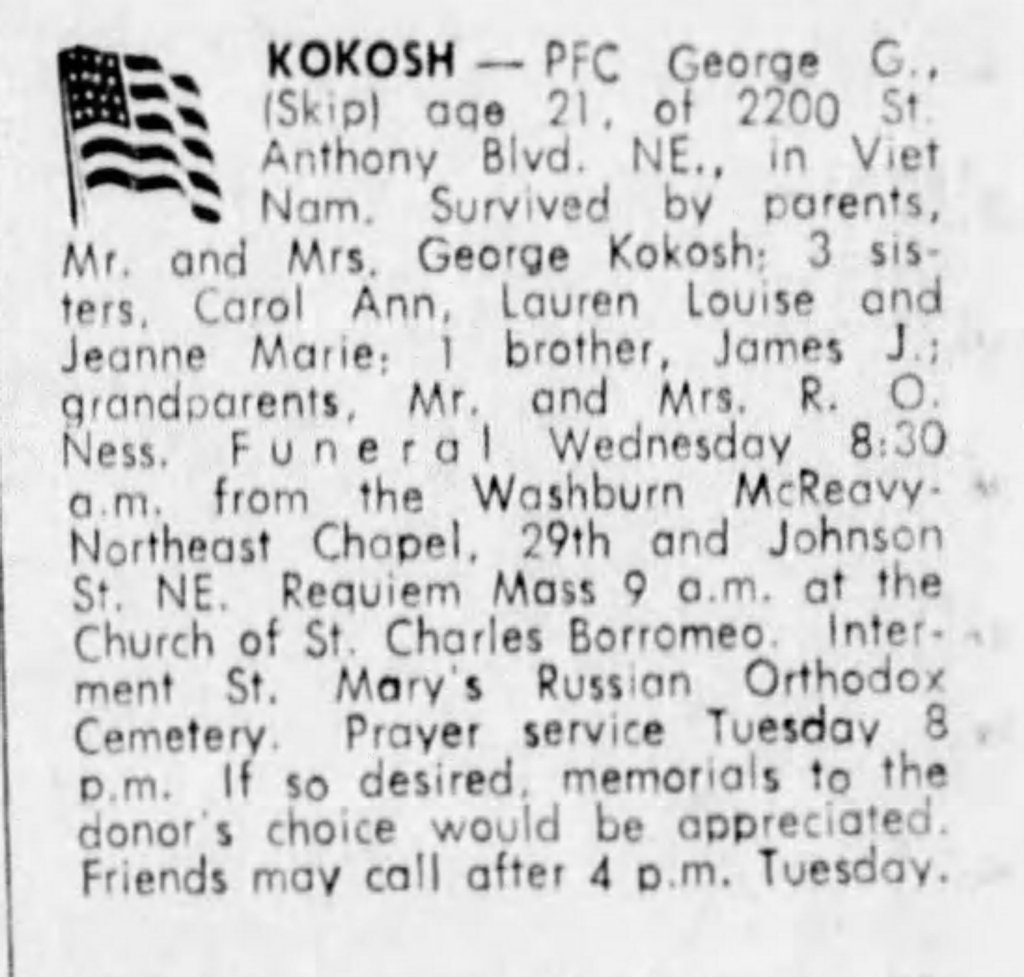
Skip is buried at St, Mary’s Russian Orthodox Cemetery in St. Anthony, MN.
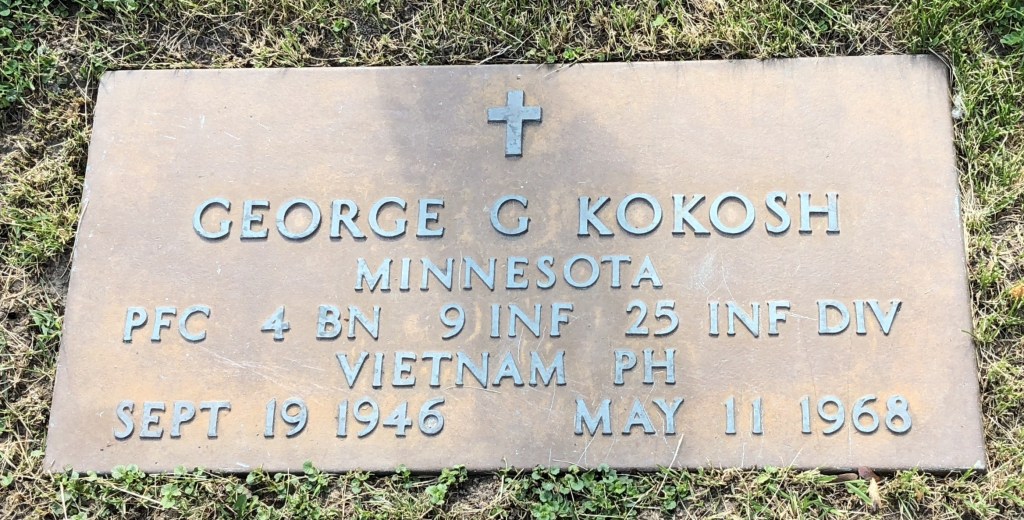
Skip is also memorialized on a monument at the cemetery dedicated to all the men from the church who have died in service to the country.

Skip’s name is also inscribed on the Vietnam Veterans Memorial in Washington, D.C. on Panel 58E, Line 23.
Postscipt
In 2013 the Star Tribune published a moving story about Skip, and a picture he had left behind for safekeeping before he went to Vietnam. It is well worth the read.
https://www.startribune.com/rosenblum-46-years-later-skip-s-print-finds-its-way-home/214229761?utm_source=copy Rosenblum, Gail, “46 years later, Skip’s print finds its way home” Start Tribune July 3, 2013.
The following excerpt is from the story. Thank you to the reporter, Gail Rosenblum (retired), for granting permission to post her work.
Merritt Bartlett knew that the young man’s name was George. He knew that George was a student at the University of Minnesota, that he was a good skier and that he had a girlfriend who lived in North Oaks.
He knew that George was drafted to Vietnam in 1968.
What 80-year-old Bartlett didn’t know until recently was what happened exactly to “Skip,” as friends called him.
Nor that after so many decades he would tear up recounting his serendipitous and, ultimately, satisfying effort to bring closure to a family who, it turns out, lives just miles from Bartlett’s home in Roseville.
It all began in Dinkytown, in 1967, with a classic Ansel Adams print.
“He skied with us,” Bartlett recalled earlier this week, taking in late-afternoon sun in his lushly landscaped back yard, courtesy of his gardener wife, Marilyn.
Back then, he and Marilyn owned a little ski and scuba shop near the U. Skip, who worked nearby, stopped in often.
“Skip would have a Coke and sit on our stairs and BS, I guess,” Bartlett said.
He remembers Skip as an All-American kid, “soft-spoken, well-educated, with a droll sense of humor.”
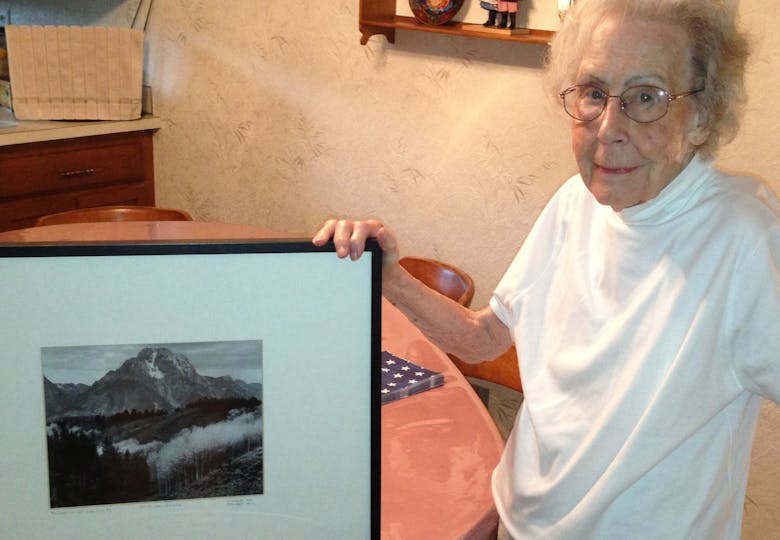
In the fall of 1967, Skip came into Bartlett’s shop carrying a signed and stamped Ansel Adams print, titled “Mount Moran, Autumn.” The photo features the majestic Grand Teton, with snow tucked into its pockets.
“It wasn’t cheap, even in those days,” Bartlett said. He doesn’t know how much Skip paid for it, but guesses it was a lot for a college kid.
“Will you store this for me?” he asked Bartlett, who said of course he would. “And then,” Bartlett said, “he left.”
Before tucking the piece away, Bartlett attached a note to the back: “Left this print in Bart’s Cafe while he was gone.”
In March 1968, Marilyn, who is retired from 3M, came across the print behind a door. She bought a mat and frame as a surprise for Skip when he returned. But he never did.
Still Bartlett held on, year after year after year. When the couple moved to Prospect Park, the print came, too. When they moved to Roseville, they packed it.
“Just in case,” Bartlett said.
Every 10 or 12 years, Bartlett made an attempt to track down the owner, but he had so little to go on in the years before the Internet. Calls to Washington, D.C., led nowhere. Nor did anything come of a “thankless” search of 20,000 U student names.
A year ago, finding Skip became all-consuming.
“I’m 80 years old,” Bartlett said, “and I’m going to die pretty soon, although not too soon. We’ve been monkeying around with this for nearly 46 years. We’ve got to get some closure.”
He sat down at his computer and printed out everything he could think of, including a list of names from the Minnesota Vietnam Veterans Memorial. He was pretty certain that George’s last name began with a K.
“Bingo! On the list from the Minnesota Memorial,” he said, “only one George K. came up.”
PFC George Gerald Kokosh. Was this his George?
He got back on the Internet and found a Washington-based Vietnam Veterans website with George Kokosh memorial pages. This George began his tour of duty on March 19, 1968. He died in combat less than two months later, on May 11, 1968. He was 21.
Bartlett also found remembrances from friends, including one named Richard who lived in Florida, but whose e-mail address used the phrase “uffda.” Bartlett saw that as promising.
“Ski buddy, friend @ the U,” Bartlett e-mailed him. “Please contact me if you see this.”
Minneapolis neighbor and childhood classmate Richard Boynton did contact Bartlett, telling him everything he needed to know, including the home address where George grew up with three sisters (Carol, Lauren and Jeannie) and a brother (Jim), his high school (Edison) and St. Mary’s Orthodox Cathedral, where Skip was active with his late father, George Sr., and where Skip’s funeral was held.
Bartlett opened his phone book. He dialed Jim Kokosh and was speechless when Jim’s mother, Mary, answered.
“I just didn’t know what to do,” said Bartlett, who never considered that Skip’s mother was still alive.
“I think I told her I had a print that belonged to her son,” he said. An understandably skeptical Jim called back. Soon after, Mary’s son-in-law, Wayne Hedalen, showed up at his door. “It went well,” Bartlett said, amused at the initial intrigue.
A week later, Mary and Jim, who live just four miles away in St. Anthony, drove to the Bartletts’ home with the high school graduation photo of Skip, an Eagle Scout and driver during the Minneapolis Aquatennial.
Jim guesses that his big brother was inspired to buy the print after a two-week family trip out West when they were kids.
No matter the reason, “she was so happy to get it,” Bartlett said of Mary, 89. And he was so happy to give it to her. “It was a relief,” he said. “It really was.”
Bartlett recently made a large donation to St. Mary’s in Skip’s memory. Mary sent Bartlett flowers at Christmastime, “to let him know I’m still thinking of him.”
“To find a man who would go to all that trouble,” Mary marvels. “Why did he do that?”
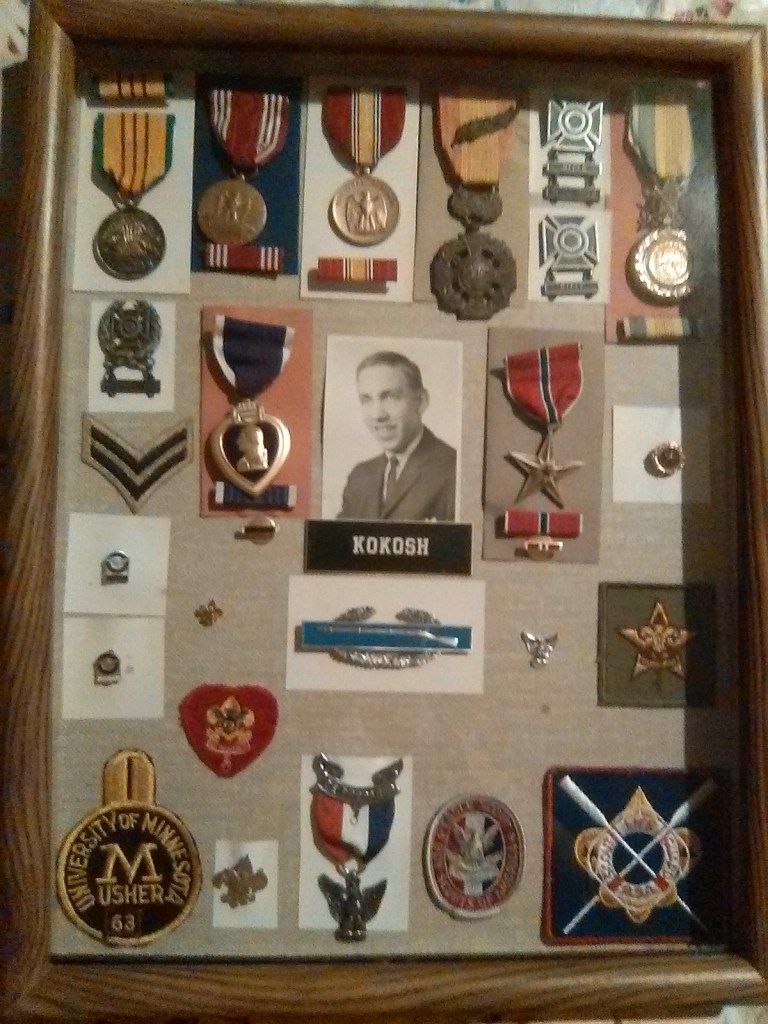
Mary has created a special space on a wall for the framed piece, along with many of Skip’s medals, including the Bronze Star and Purple Heart.
“People ask me, ‘Oh, don’t you want to sell it?’ ” Mary shakes her head.
“No, I don’t want to sell it.”
 Edison Heroes