
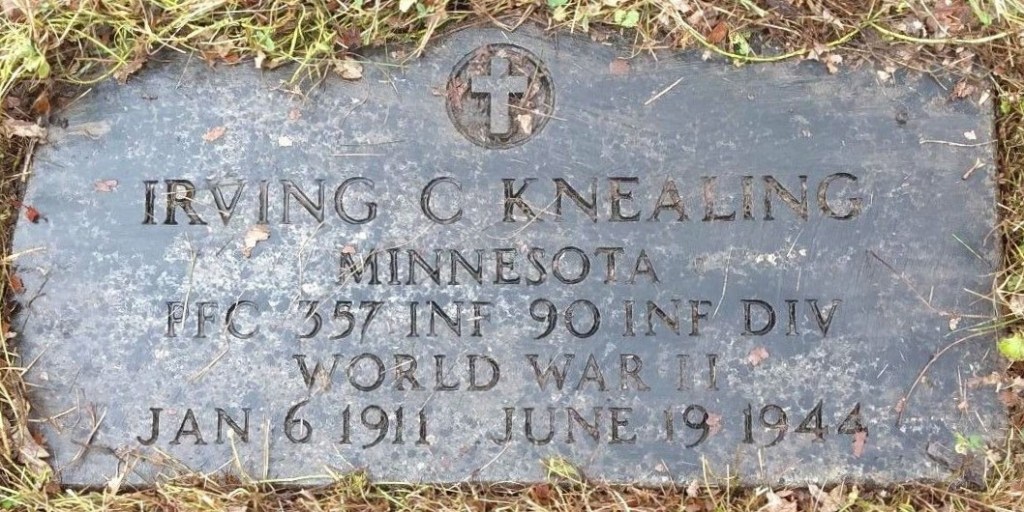
6Jan1911 – 19Jun1944
Edison Days
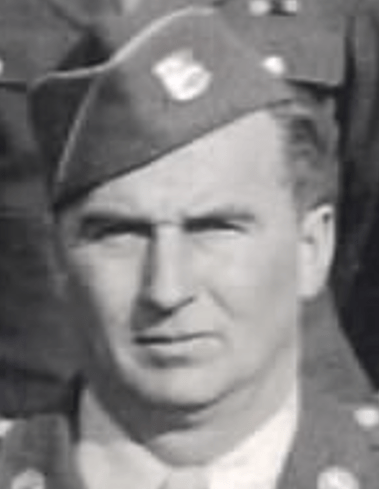
Irving is included in the “In Memoriam” section of the 1946 Edison Yearbook. No pictures of his time at Edison have been found.
Military Service


Branch: United States Army
Rank: Private
Unit: Headquarters Company – 357th Infantry Regiment – 90th Infantry Division
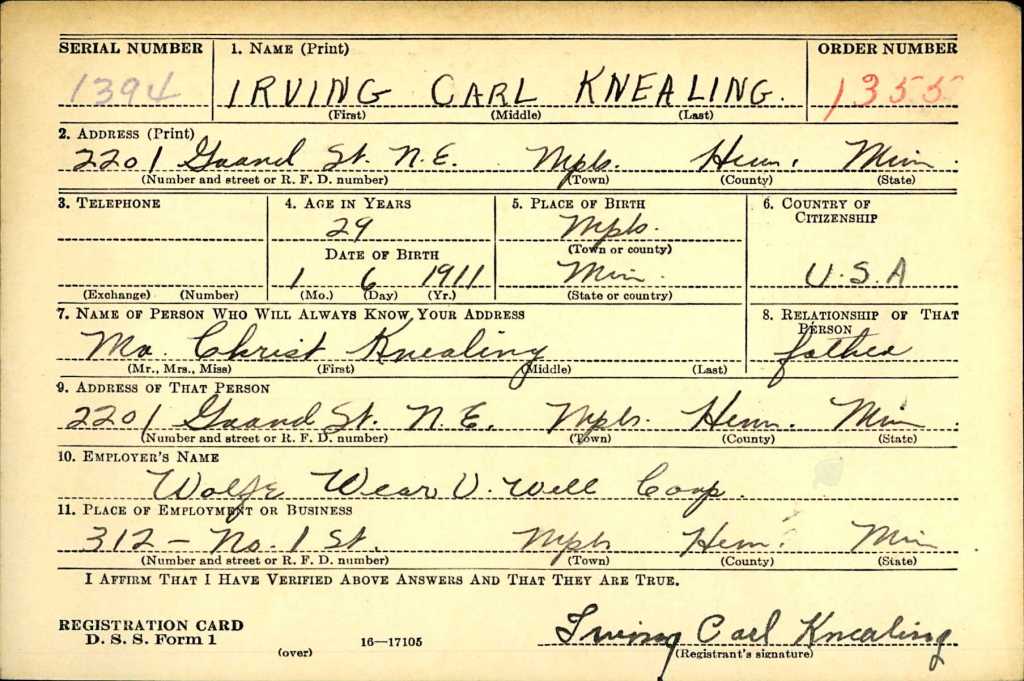
Irving joined the Army 17Mar1942. It is unknown as to when he joined the 357th Infantry Regiment. He was with the 357th when by the time they began the long journey to Europe.
On 31Dec1943 Irving and the 357th arrived at Fort Dix, New Jersey. There, they underwent additional training until March 1944.
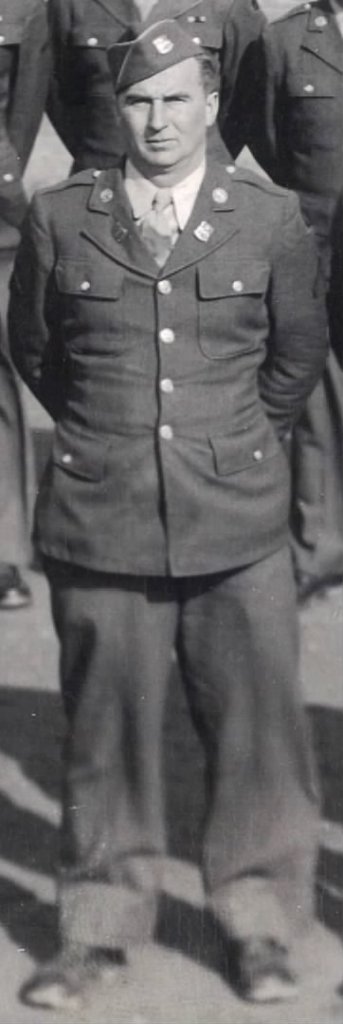
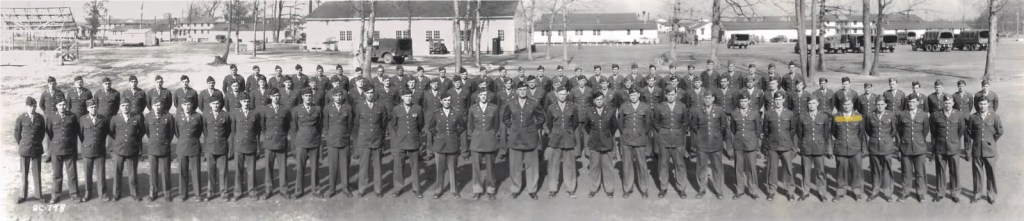
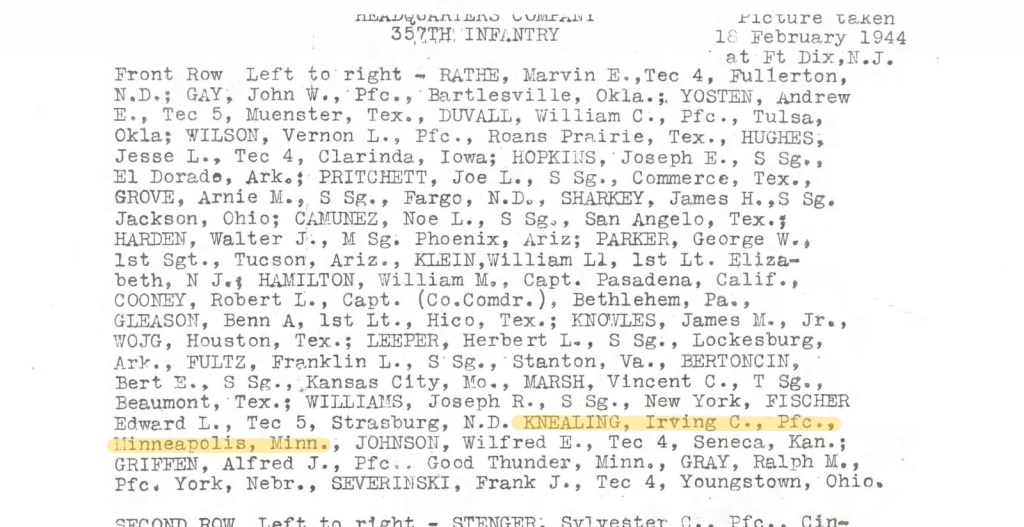
Irving and the 357th sailed for England on 23Mar1944 arriving on 4Apr1944. The next 2 months were spent intensively training in preparation for combat. On 8Jun1944, just 2 days after the D-Day invasion, the 357th landed on Utah Beach.
On 9Jun1944 the 357th saw their first combat
The following is an excerpt from a unit history of the 357th Infantry Regiment.
On the 9th, orders were received to pass through elements of the 82nd Airborne Division near Amfreville by daylight of the 10th and seize and secure crossings of the Douve River west of St. Columbe. As this movement was being executed, the Regiment received its first casualties in land action against the enemy from 88mm fire. The saying that first impressions are the greatest held true in this case, as this wicked weapon, employed so effectively by the enemy throughout the Normandy campaign, soon was familiar to everyone, and it’s name became almost a byword.
When daylight came, the 2nd and 3rd Battalions, from left to right, jumped off and met surprisingly little resistance. Signs of recent vicious combat between the Airborne men and the enemy were everywhere, and everyone felt in his bones it was just a matter of time until the show would start for the 357th. As the advance began, an officer in “L” Company was credited as being the first man in the Regiment to kill a German. They met face to face coming around the corner of a building.
At noon the enemy defense line was reached. Darkness found the Regiment still attacking in the face of withering enemy mortar and machine gun fire. It seemed that every German had an automatic weapon, and mortar shells seemed to follow the men right into their holes and ditches. Casualties were heavy and gains could be measured in yards.
World war II had begun in earnest for the new 357th Infantry. The day had been the longest the men had ever spent. The initial shock of seeing old friends struck down had been great and it was evident that much fierce fighting lay ahead. The hedgerow country of Normandy was nature’s gift to the defenders. The countryside was divided into tiny fields, each bounded by a drainage ditch covered over with a high dense hedge. This offered an almost perfect defense system for the camouflage-wise Germans. It was all but impossible to see them and their cleverly constructed and camouflaged hedgerow positions. Snipers, dressed in camouflage suits, were most troublesome in the wooded areas and were responsible for many casualties behind the lines. It was days before many of the front line rifleman even
saw a live German to shoot at.
The task was clear. The beachhead had to be expanded before any sizable forces could be landed in the battle of maneuver began. There was essentially one way that this could be done and that was by frontal assault by the infantry against prepared enemy positions. The enemy knew it and so did the men of the Regiment. Consequently, the days that followed brought one of the worst baptisms of fire ever undergone by an American infantry unit. To attack as long as there was daylight was the only order. To advance from one hedgerow to another, the distance of perhaps 100 to 200 yards, was a day’s job and a costly one. The Germans were putting up fanatical resistance. Expenditure of ammunition on both sides
was tremendous. Every field was literally pocked with mortar and artillery shell holes, 88mm shells whined down every road.
By the end of the 13th, the Regiment in 4 days of combat had suffered a total of 703 casualties, including 133 dead. It was during this time that the value of a steady stream of good reinforcements was realized. Attacks were being launched toward Gourbesville against unrelenting enemy resistance. On the 13th, Colonel Sheehy re-assumed command of the Regiment.
On the 15th, the 3rd Battalion captured Gourbesville after overcoming fierce enemy resistance. During this operation, the Regiment lost its beloved commander who had so recently taken command of the unit which he had helped mold during training. Colonel Sheehy was killed when his vehicle was ambushed as he was proceeding to front line positions. On the following day, Colonel George B. Barth, former chief of staff of the 9th Infantry Division during action in Africa, assumed command of the Regiment.
At this time, the 9th Division had driven across the Cotentin Peninsula to the coast and the drive toward Cherbourg had begun. To prevent the Germans from leaving or entering the peninsula was the mission assignment of the Regiment on the 18th. Following a 15 mile motor movement, the battalions moved into position during the 18th and 19th. During this operation, 66 prisoners, including 5 officers, were taken as they were attempting to infiltrate to the south through the 3rd Battalion lines.
The enemy immediately exerted pressure from the south in an attempt to break through to the entrapped forces in the peninsula. Simultaneously, other large groups were attempting to break out from the north and escape the trap. Sharp encounters resulted from these enemy efforts which were often supported by armor, as well as heavy artillery and mortar fire.
Irving was seriously wounded by artillery fire on June 18 .
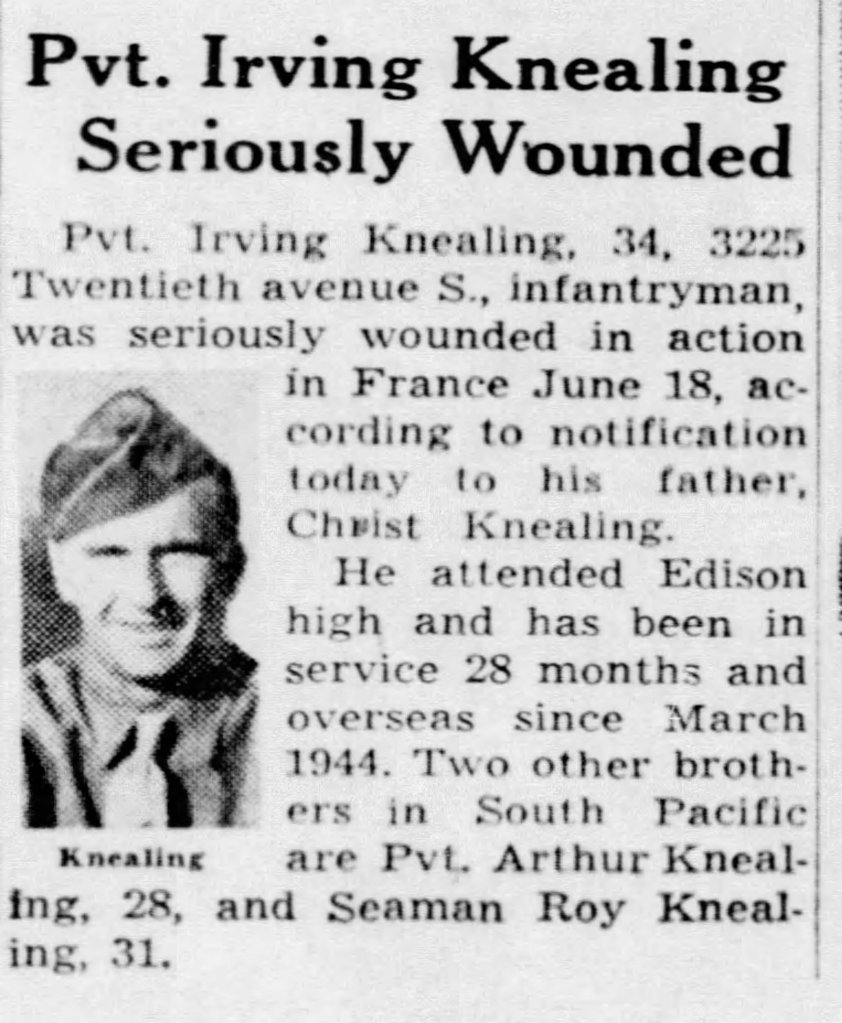
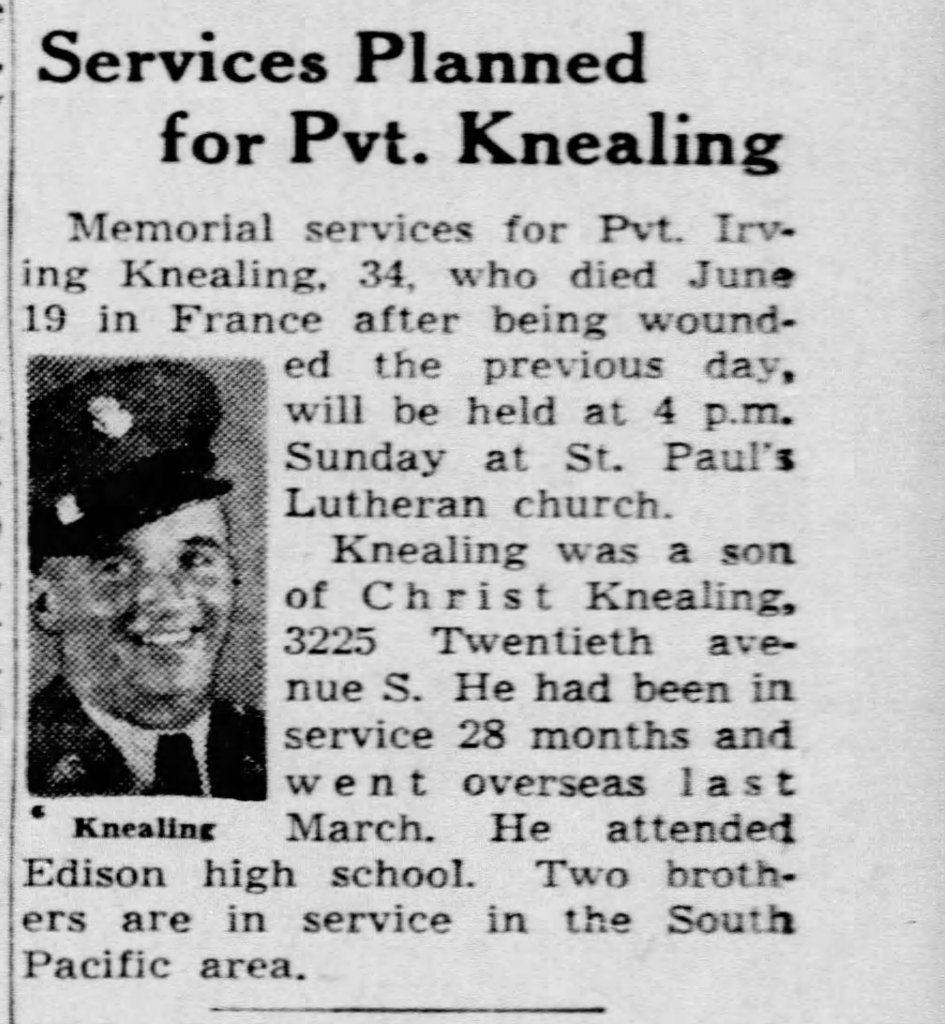
He succumbed to his wounds the next day.

Irving was buried in a temporary military cemetery in France.
His family held a memorial service for him on 10Aug1944.
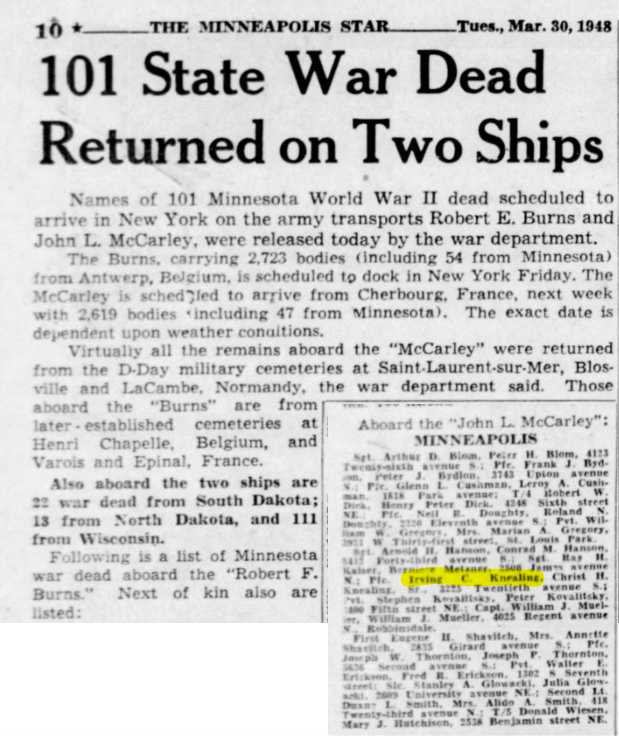
In April 1948 Irving’s remains were returned to Minnesota for reburial.
Reburial services for Irving were held on 8May1948.
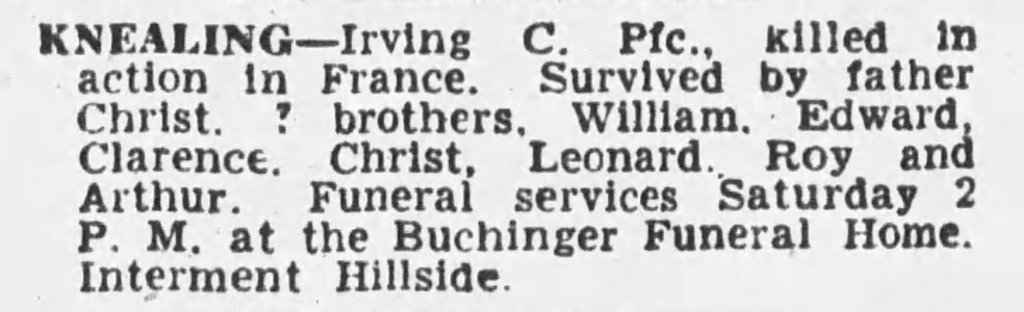
Irving is buried at Hillside Cemetery in Minneapolis, MN.

 Edison Heroes