
16Jun1914 – 08Jun1944
Edison Days
The only record of Paul’s attendance at Edison is his inclusion in the “In Memoriam” section of the 1946 Wizard yearbook.
Military Service
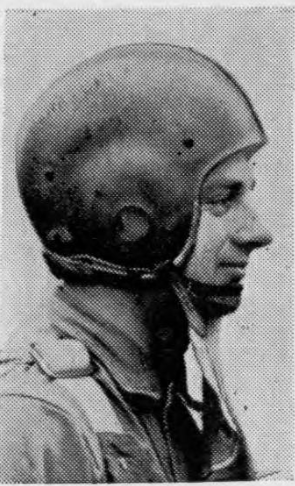
Branch: United States Army
Rank: Private First Class
Unit: Company H – 506th Parachute Infantry Regiment – 101st Airborne Division
Paul enlisted in the Army on 24Jun1942 at the Presideo of Monterey in California. After basic training it appears that he joined the newly formed 502nd Parachute Infantry Regiment (PIR) of the 101st Airborne Division.
It is likely that Paul’s airborne training started at Fort Bragg NC. For the remainder of 1942 and into 1943 the 502nd PIR took part in a grueling training program, which consisted of individual, unit, and combined division training. During March 1943 they took part in division maneuvers at Southern Pines in North Carolina. This was followed by the Camden maneuvers which started on May 23rd of that year. Shortly after the Camden Maneuvers the big Tennessee maneuvers were held.
On 4Sep1943 Paul and the men of the 502nd boarded the SS Strathnaver bound for their new home in England. The Strathnaver sailed for 6 days before she had to make port on 11 September in St. Johns Newfoundland for repairs. The journey eventually would end up taking a total of 44 days because of the discovery of salt water in the ships fresh water tanks and other non-related mishaps. On 4 October the SS John Ericsson picked the men up and finally set sail for England arriving in Liverpool on 18 October . They settled into quarters in the Chilton Foliat and Denford near Hungerford, Berkshire which would be their new home for the next seven months. Paul and the 502nd troopers continued their rigorous training which included 15 to 25 mile hikes and daily close combat exercises. Instructions were given in a wide variety of items from 1st-aid, map reading, chemical warfare and the use and firing of German weapons. Company and battalion size parachute drops where also rehearsed during this period.
On D-Day, 6Jun1944, Paul and the 502nd boarded C-47 transport planes at Membury and Greenham Common as part of the the first wave to depart for France. The 502nd PIR headed for drop zone A. Their mission was to secure two northern causeways leading inland from Utah Beach and destroy a German coast-artillery battery near Ste Martin-de-Varreville. In the predawn hours of D-Day, a combination of low clouds, and enemy anti-aircraft fire, caused the break-up of the troop carrier formations. The scattering of the air armada was such that the sporadic jump patterns caused most of the battalions to land far afield of their designated DZ. Some of the men landed as far away as 5 miles from the designated area.
Paul’s Company H, part of the 3rd Battalion led by Lt Col Robert G Cole was responsible for securing the two causeways. Undaunted by the confusion, Lt Col Cole gradually collected his men and achieved his objective.
Paul’s exact fate on D-day and the days following are unknown. Initial reports in the Minneapolis paper indicated that he was killed in action on 30Jun1944 while on a special mission. There is no indication that this report was valid.
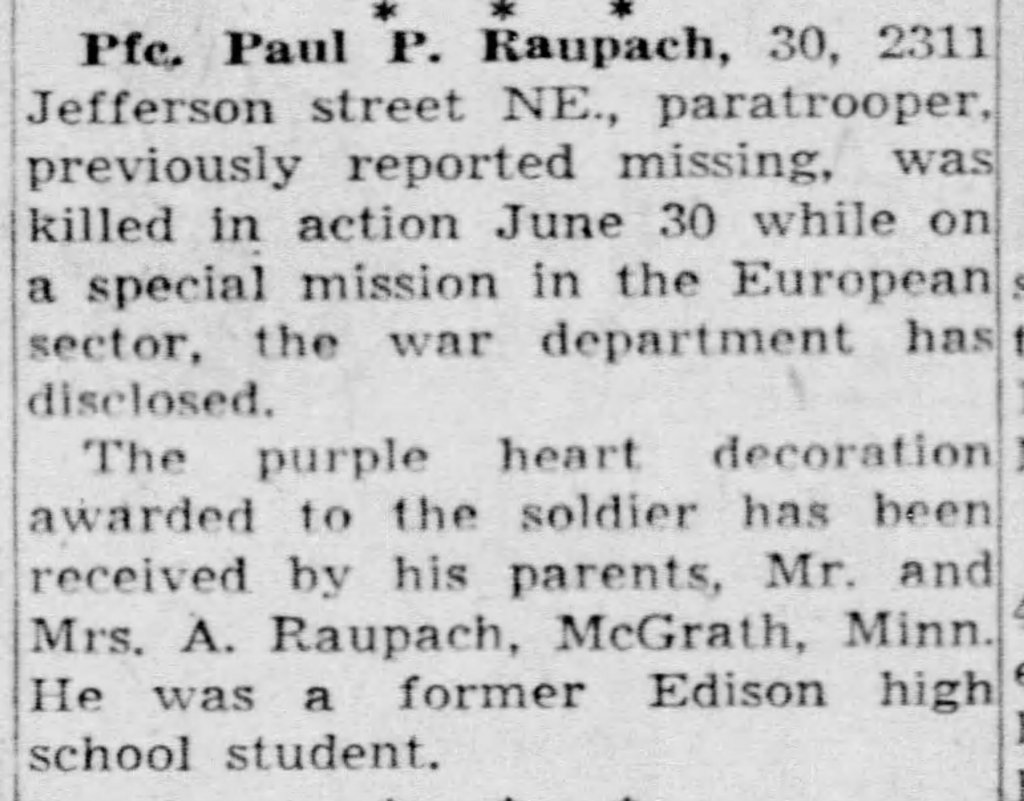
A prominent website dedicated to the 101st Airborne Division lists his date of death as 10Jun1944. While Paul’s company was involved in heavy fighting that day and suffered a high casualty rate, there is no evidence that Paul participated in that action.
It is likely that Paul was killed in action on 8June1844. The circumstances of his death are unknown.
Paul was buried in a temporary cemetery at Sainte-Mère-Église, France. In 1949 his remains were returned to California. He is buried at Golden Gate National Cemetery in San Bruno, CA.
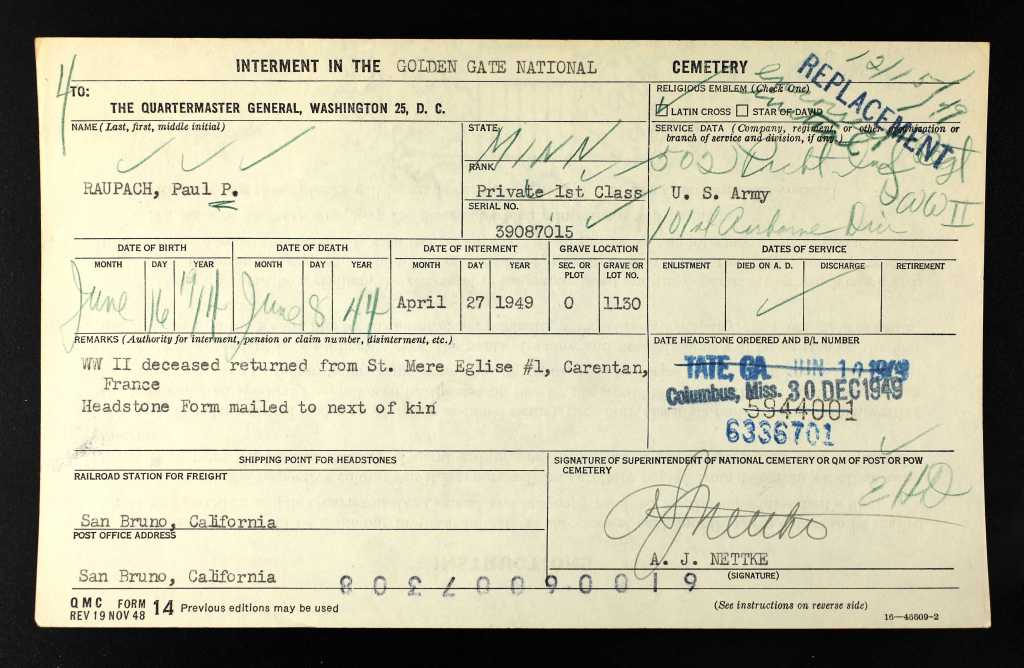
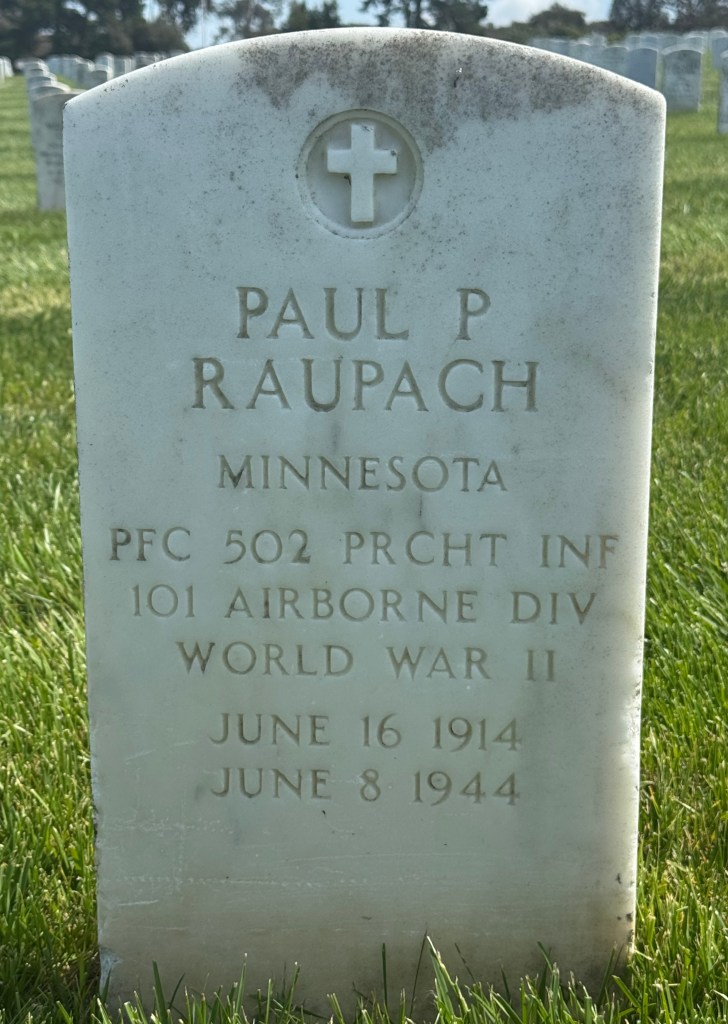
While not as well-known as the 506th PIR (of Band of Brothers fame), Paul and the 502nd PIR had identical training as the 506th and had similar experiences on D-Day and the days after. I recommend watching Episodes 1, 2, and 3 of the HBO mini-series Band of Brothers to get a sense for what Paul’s experience as a paratrooper could have looked like.
 Edison Heroes