
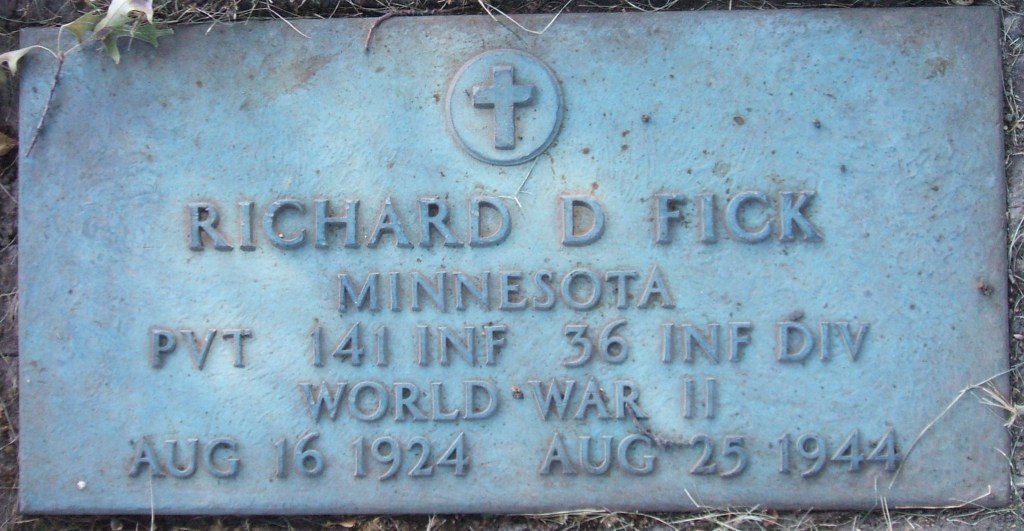
16Aug1924 – 25Aug1944
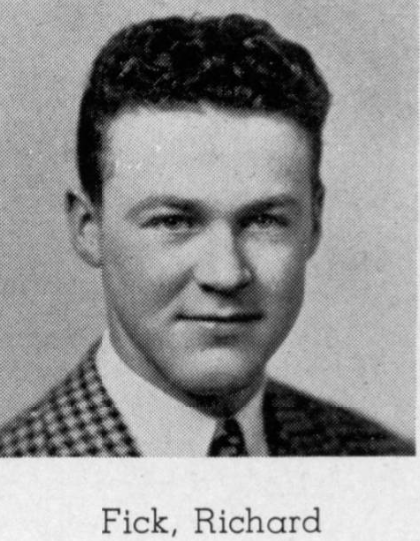

Edison Days
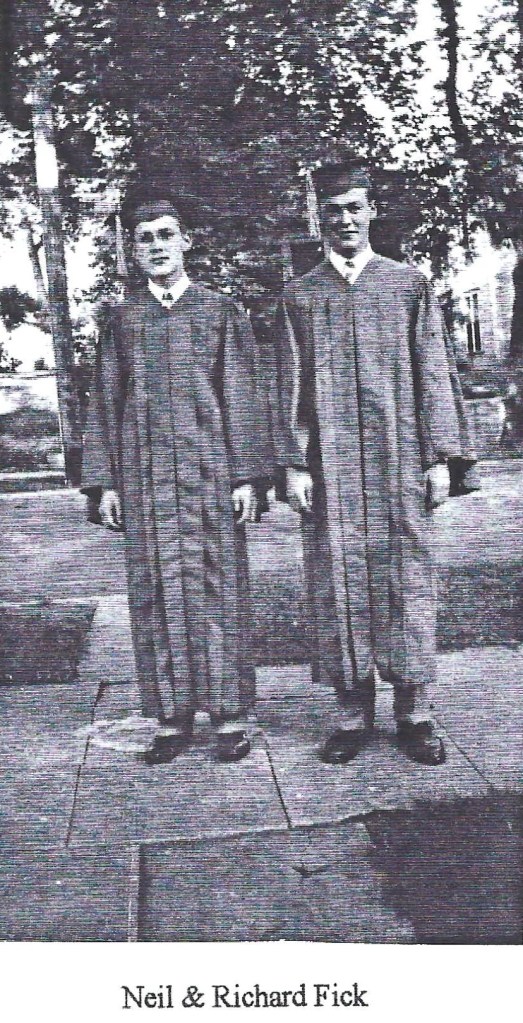
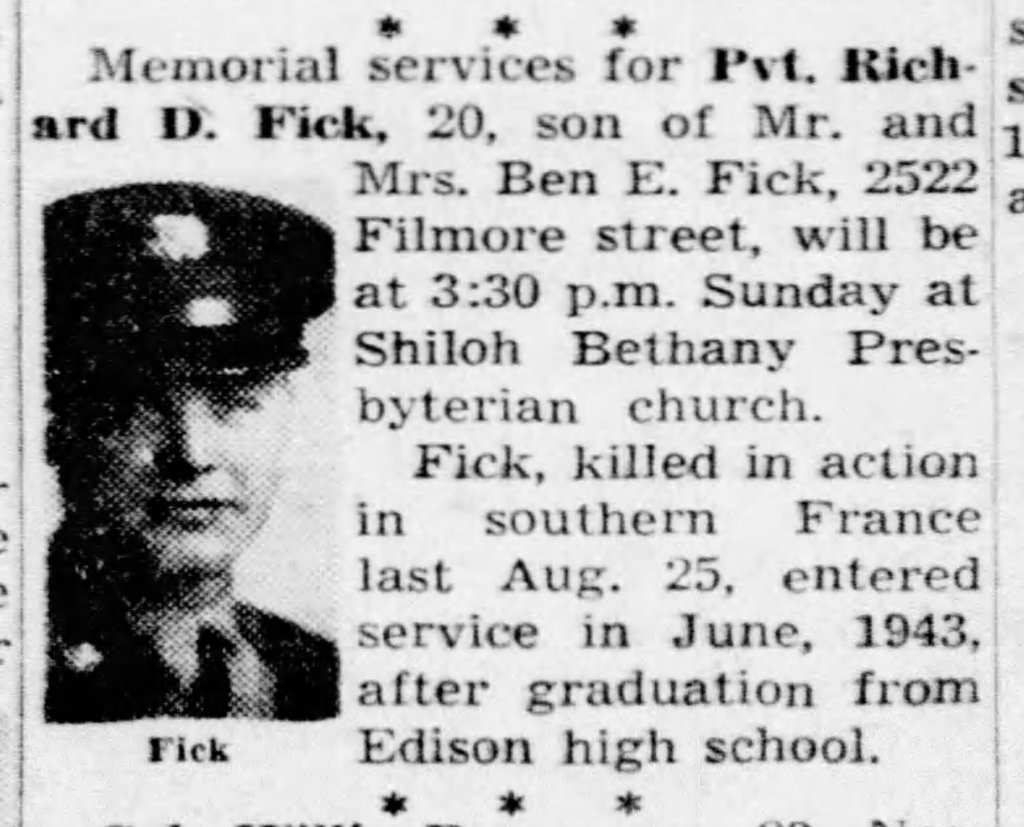
Richard graduated with the Class of June 1943. He was involved with Hi-Y. He was a Library Monitor, and he played on the Tennis team.

Military Service
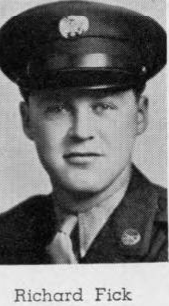

Branch: United States Army
Rank: Private
Unit: E Company – 141st Infantry Regiment – 36th Infantry Division.
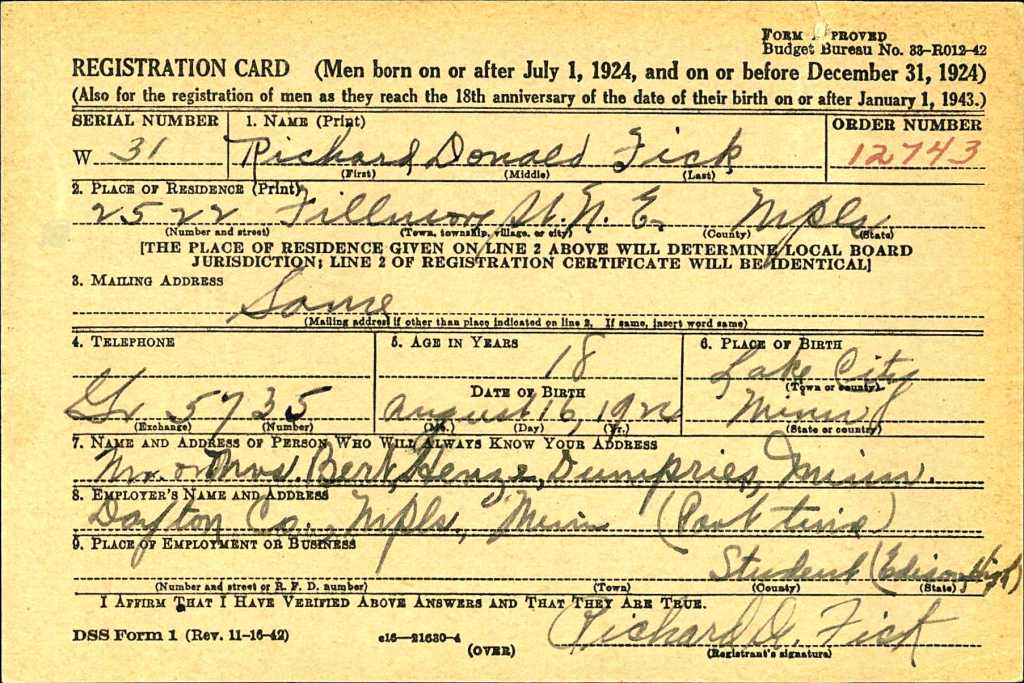
Richard enlisted in the Army on 8Jun1943 right after high school graduation.
Richard went to basic training at the Infantry Replacement Training Center at Fort McClellan in Anniston, Alabama. 9 weeks long, basic training included situations corresponding to combat in European areas such as training within simulated urban areas, actions under live artillery fire, and crouching in foxholes with tanks moving overhead.
Richard went overseas in April 1944. It is unknown if he first went to a replacement depot in England, or if he joined the 141st Infantry Regiment in Italy.
Regardless of Richard’s path to the 141st, it is highly probable that he was involved in Operation Dragoon, the invasion of southern France on 15Aug1944. Richard and the 141st landed near Saint-Raphael, France. Unlike the D-Day invasion, Operation Dragoon was met with light German resistance and with few Allied casualties.
After a futile counterattack against the Allied landing forces, the German’s began an organized withdrawal to the North
The Allies were able to decipher the German withdrawal plans enabling them to devise a plan to cut the German’s off near the small town of Montélimar, France. The plan was to be led by Taskforce Butler, with the 36th Infantry Division trailing behind them. However, after their speedy advance, the forward Allied forces suffered from a serious lack of fuel and supplies, making their task difficult.
On 21 August, Taskforce Butler occupied the hills north of the town of Montélimar. From this position, Taskforce Butler fired on the evacuating German troops, while waiting for further reinforcements. Troops from the Free French Forces supported the Americans, harassing German troops through the entire battle. The sudden appearance of this new threat shocked the German command. As a first countermeasure, the 11th Panzer Division was called in. The first of its units to arrive, together with several ad hoc Luftwaffe battle groups, were asked to deal with this new threat. This hastily assembled force mounted an attack against the same day, and the Germans were able to isolate Taskforce Butler from supplies. This success was short-lived, and the Germans were soon pushed back.
The next day, the first units of the 36th Division arrived, reinforcing Taskforce Butler. However, the Allied troops were still short of supplies and lacked enough men to directly attack the German escape route. During the next few days, more Allied men and supplies trickled in. At the same time, the US 45th Division took over positions at Grenoble, leaving the 36th Division free to fully commit its forces at Montélimar. Taskforce Butler was officially dissolved on 23 August, and John E. Dahlquist, commander of the now fully-arrived 36th Infantry Division, assumed direct control of its units. For the rest of the day, only small skirmishes occurred between German and Allied forces. Meanwhile, the Germans also struggled to bring the 11th Panzer Division through the chaos of the evacuation into position in the town. By 24 August, a substantial number of the 11th Panzer Division had finally reached the battle area.
With his newly reorganized units, Dahlquist attempted a direct attack against Montélimar, which failed against the newly arrived German tank units. The subsequent German counterattack gained some ground against the hills occupied by the Allies. Its aim was to push the Americans from the hills north of Montélimar and to force the American artillery to move back out of range. After the fighting, the Germans captured a copy of Dahlquist’s operational plans, giving them a better picture of the Allied forces. As a result, the German’s planned a major attack for 25 August by the 11th Panzer Division and the 198th Infantry Division, together with some ad hoc Luftwaffe battlegroups. This attack was, however, also a failure. The Allies struck back and retook the hills north of Montélimar, and were able to establish a temporary roadblock on the German escape route. Again, this Allied success also did not last long, as another attack led by the German’s reopened the passage at midnight.
Richard was killed in action on 25 August in the fighting around Montélimar. The circumstances of his death are unknown. He was one of 1,575 Americans killed or wounded in the 8-day battle.
Richard’s family was initially told he was missing in action.

It would some months before they were given the news that he had been killed in action.
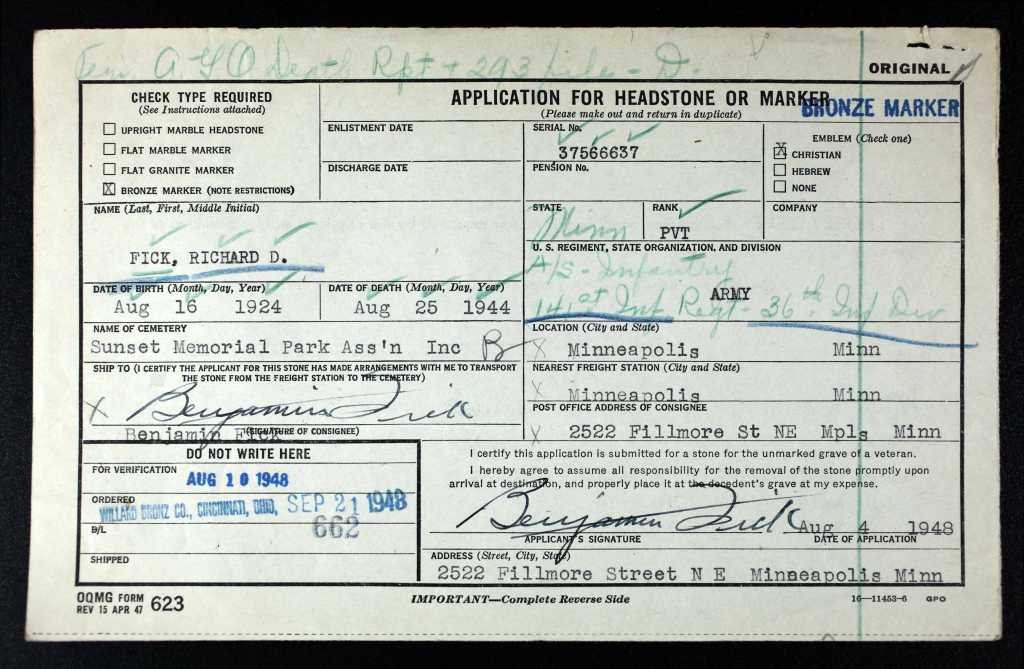
Originally buried in a temporary cemetery in France, Richard’s remains were returned to Minnesota for reburial in 1948.
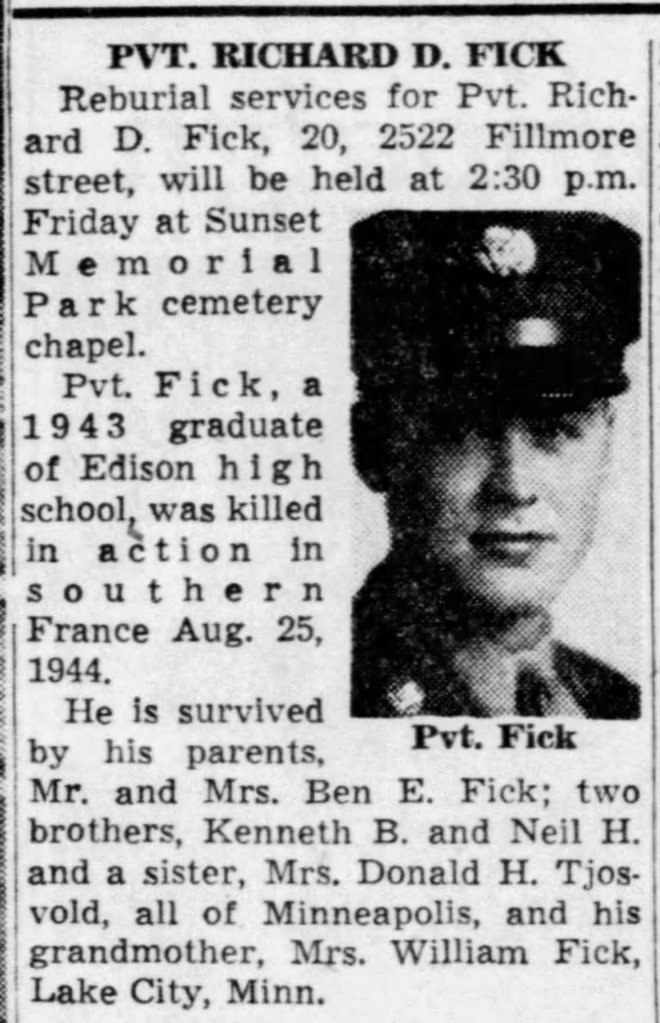
Richard is buried at Sunset Memorial Park Cemetery in Minneapolis, Minnesota.
 Edison Heroes