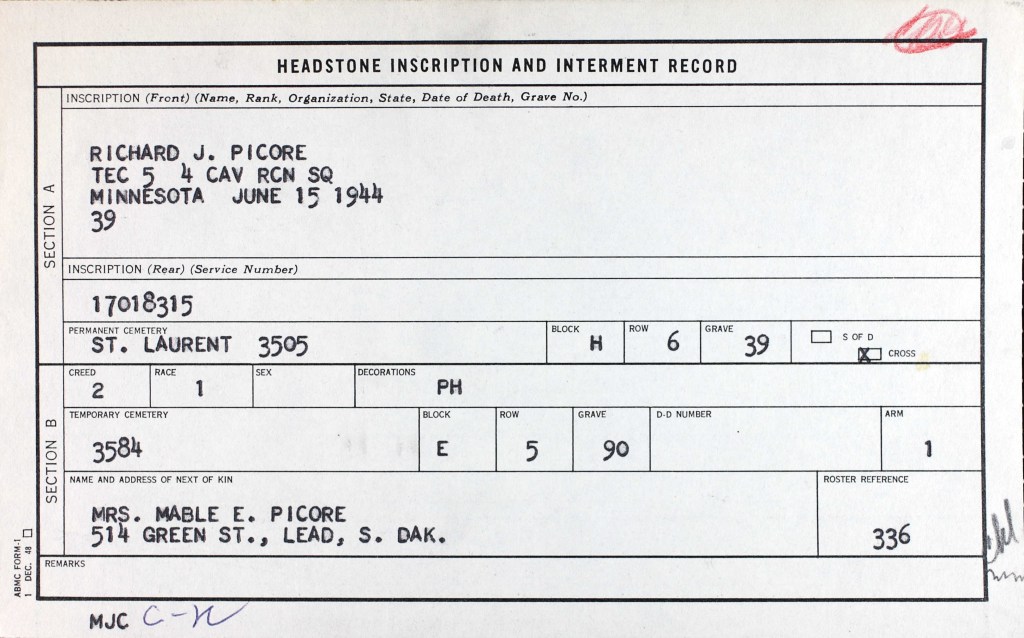
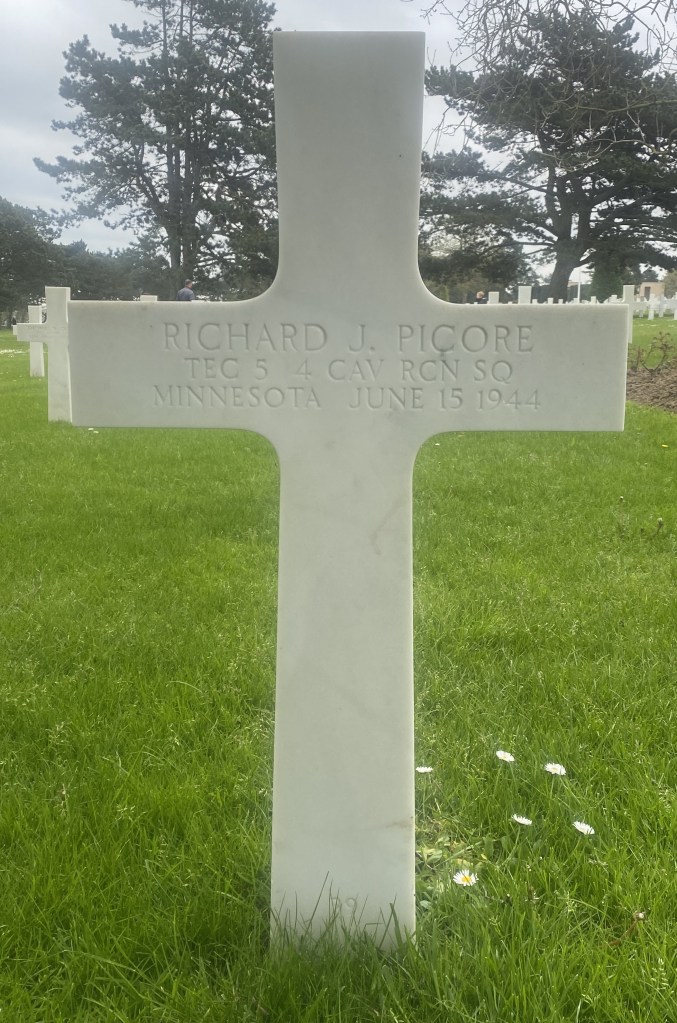
27Dec1923 – 15Jun1944
Edison Days
Richard attended Edison but withdrew without graduating.
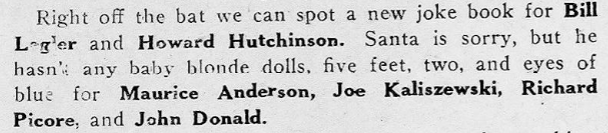
He was mentioned in the Edison Record newspaper in 1939.
Military Service
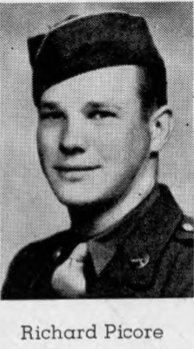

Rank: Technician 5th Grade
Branch: United States Army
Unit: Troop B – 4th Cavalry Reconnaissance Squadron
Richard enlisted in the Army at Fort Snelling, Minnesota on 3Jan1941. It is unknown where he attended basic training. Prior to going overseas, Richard trained at Fort Meade, South Dakota, Camp Young, California, and Camp Maxey, TX.
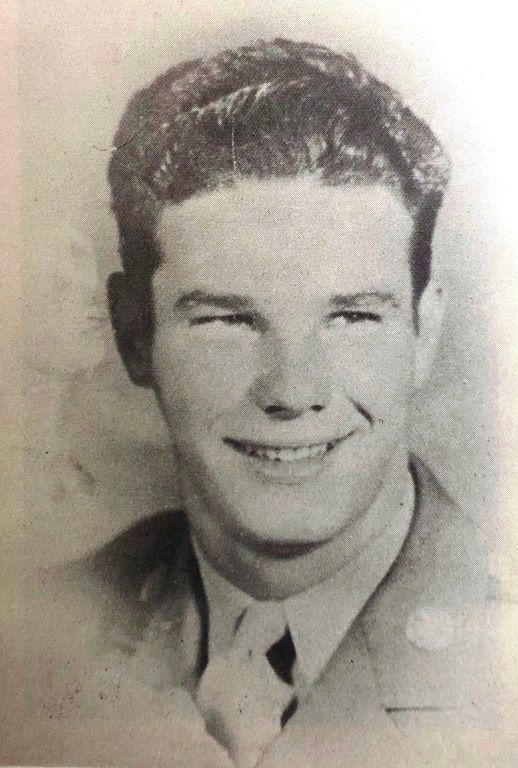
Richard and his unit went overseas in December 1943. After 6 months of training, the squadron participated in the D-day landings on 6Jun1944.
The following excerpt is from a unit history of the squadron.
The 4th Reconnaissance Troop arrived on the Continent at 0930 on D-Day [they landed at Utah Beach], but with only two operational vehicles failed to accomplish its first mission of linking up with the paratroopers at St. Mere Eglise. The entire troop assembled by 9 June and throughout the remainder of the next two months supported the 4th Infantry Division’s fight in the bocage with security patrols and reconnaissance. The troop also experienced frequent attachment to the 24th Cavalry Reconnaissance Squadron.
A permanent fixture in every division and well established by 1944, these units ultimately received less attention in the final analysis of what had been good and bad about ground reconnaissance when World War II ended. Far more numerous than the cavalry groups, their contributions to the first six months in Europe were considerable, but not the primary focus of this or the next chapter.
Like previous missions in which commanders committed mechanized reconnaissance
units in piecemeal fashion, the same disastrous results awaited the untested cavalrymen. Captain William Larned’s Troop B, 4th Cavalry Reconnaissance Squadron found itself attached to the 82d Airborne Division from 6 June-3 July 1944.
As if taken from the script of a Hollywood Western, Larned’s mission was to link-up with the lightly armed and supplied paratroopers and in doing so, provide them the additional firepower required to repulse the expected hostile onslaught, in this case Nazis, not native Americans.
Second Lieutenant Gerald H. Penley led his platoon across Utah beach at 0930 on D-Day and proceeded to fight his way through to elements of the 82nd Airborne Division at Ste Mere Eglise. Joined a few days later by the remainder of Troop B, the 82d Airborne Division assigned the cavalry troop combat patrols in the hedgerow country and enjoyed the additional firepower the troop brought with it in the form of 37 mm cannons and machine guns.
It was on one of these platoon-sized patrols that the troop lost an entire platoon of
men and vehicles, less one jeep and two scouts who managed to escape. Lacking the support of the troop’s other platoons, and beyond the support of the other assets found in every mechanized reconnaissance squadron, the lightly armed platoon fared poorly.
It is believed that the patrol referenced above took place on 11June1944. Richard was originally listed as missing in action.
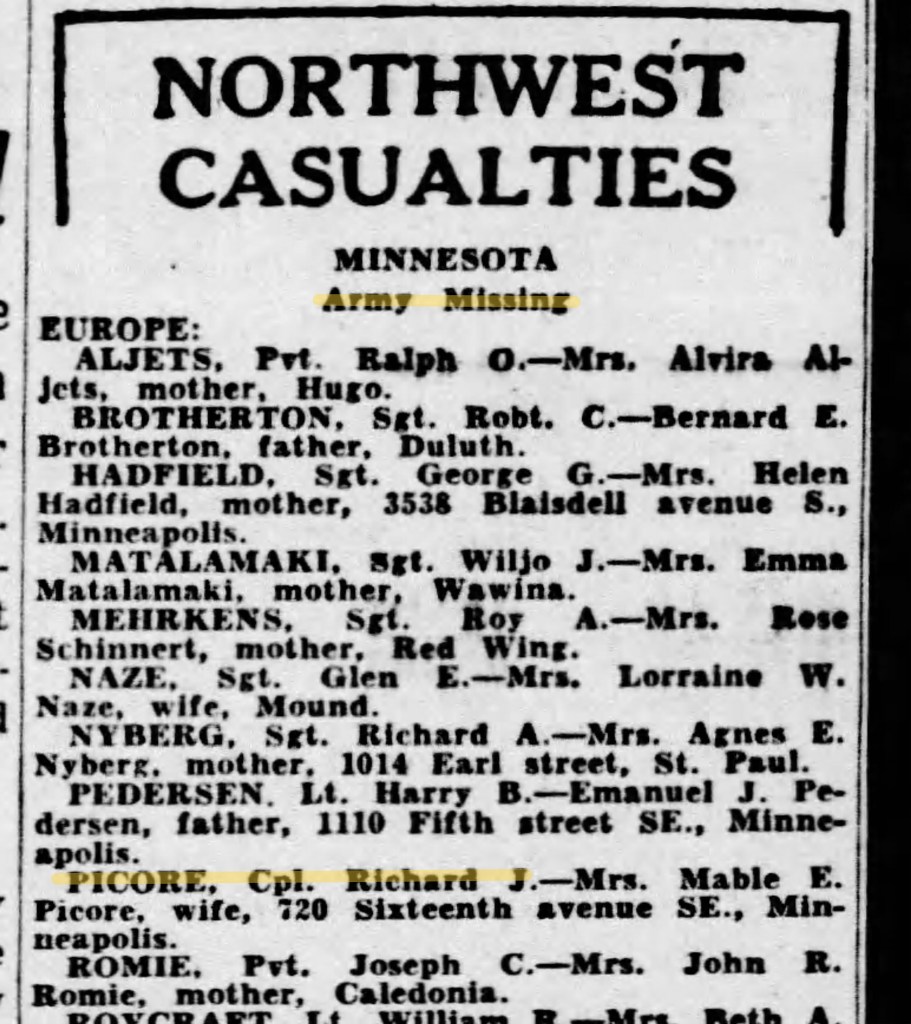
4 days later, on June 15, Richard’s status was changed to killed in action. He had been killed by German mortar or artillery fire.
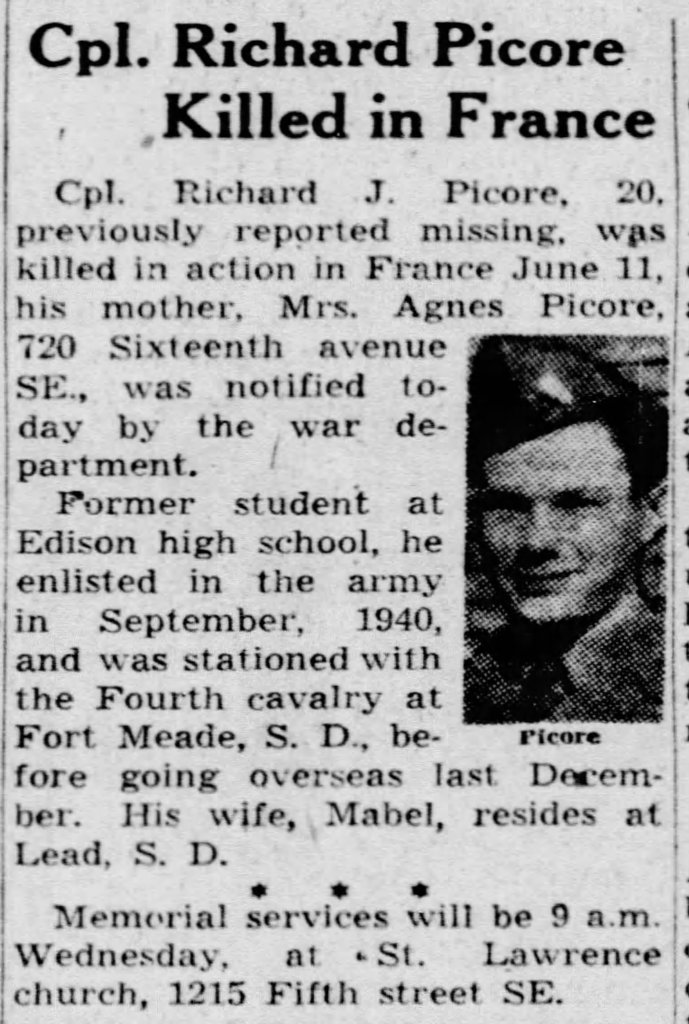
Richard was originally buried in a temporary cemetery near Ste Mere Eglise, France.
After the war, Richard’s family chose to leave his remains in Europe.
Richard is 1 of 9,389 U.S. service members buried at the Normandy American Cemetery and Memorial in Colleville-sur-Mer, France.