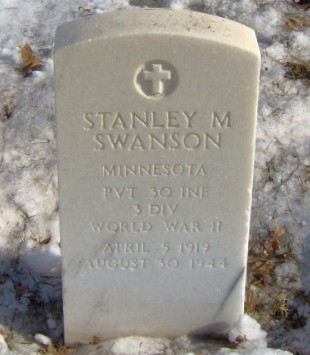
5Apri1919 – 30Aug1944
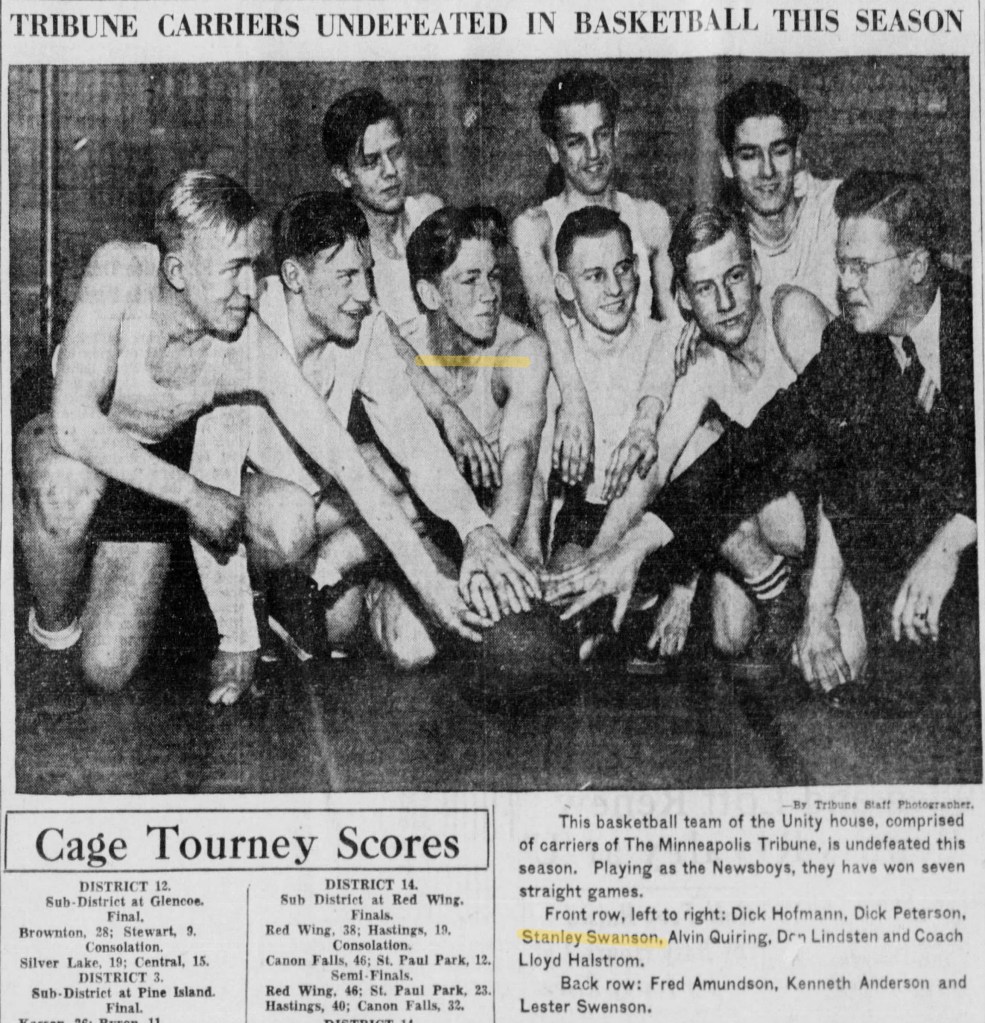
Edison Days
Stanley attended Edison but withdrew without graduating.
Military Service
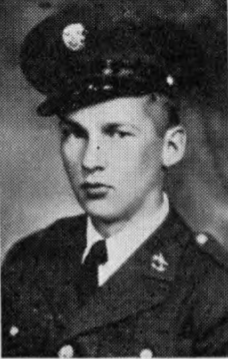

Rank: Private
Branch: United States Army
Unit: HQ Company – 1st Batallion – 30th Infantry Regiment – 3rd Infantry Division
A letter from Stanley’s mother to the Army after his death states that she signed papers allowing him to enlist when he was 17 years old. It is unknown where he attended basic training.
On 15Dec1937 Stanley boarded a troop transport ship in San Francisco, California bound for Schofield Barracks on Oahu, Hawaii. He was a Private in the 8th Field Artillery Brigade. On 13Mar1939 his trip was reversed. He sailed from Hawaii back to California.
It is likely that Stanley joined the 30th Infantry Regiment when he returned from Hawaii as that unit was based in San Francisco. The regiment was reassigned to the 3rd Division at the Presidio of San Francisco in May 1940 and moved to Fort Lewis, Washington, on 31Mar1941. Through 1941–42 it trained with the division at Fort Lewis, Fort Ord, California, and Camp Pickett, Virginia.
In October 1942 Stanley was on a ship headed toward North Africa. The United States was soon to enter ground combat against the Gemans in North Africa.
On 8Nov1942 Stanley and the 30th Regiment participated in the amphibious landings in Morrocco.
2 days later, on November 10, Stanley’s actions in combat earned him the Silver Star, the Nation’s 3rd highest award for valor.
The exact events of his actions are unknown. His citation reads:
The President of the United States of America, authorized by Act of Congress July 9, 1918, takes pleasure in presenting the Silver Star to Private Stanley Swanson, United States Army, for gallantry in action while serving with Headquarters Company, 1st Battalion, 30th Infantry Regiment, 3d Infantry Division, in action against the enemy in French Morocco, on 10 November 1942. His gallant actions and dedicated devotion to duty, without regard for his own life, were in keeping with the highest traditions of military service and reflect great credit upon himself and the United States Army.
The details of Stanley’s service are unknown; however, records indicate that he was with the 30th regiment as they fought in Tunisia, the invasion of Sicily, the Naples-Foggia campaign, the landings at Anzio, and the Rome-Arno campaign.
At some point during this 2-year period Stanley was wounded in action and was awarded the Purple Heart. The nature of his wounds is unknown. Also, during this period Stanley returned back to Minnesota on a furlough. The date and duration of his visit are also unknown, as if the 2 events are related.
Next up for Stanley and the 30th Infantry Regiment was Operation Dragoon. Operation Dragoon was the amphibious invasion of southern France along the French Riviera. Starting on 15Aug1944, the invasion sought to secure the vital ports on the French Mediterranean coast and increase pressure on the German forces by opening another front.
The regiment landed on August 28 at Cavalaire-sur-Mer near Saint-Tropez, where it came ashore in reserve behind the division’s other regiments before joining the drive northward and northwestward up the Rhône River valley.
It is believed that Stanley was a part of an Intelligence and Reconnaissance (I & R) Platoon within HQ Company at this time. The work of the I & R Platoon included: Patrol well ahead of the rifle battalions and keep contact with the enemy. Scout roads, river crossings, defiles, and likely ambush or roadblock sites before the main body moved. Run 24-hour observation and listening posts. Watch the regiment’s flanks and regain contact with neighboring units if it was lost. Keep in touch with the division’s 3rd Reconnaissance Troop when that troop was working in front of or beside the regiment. Sketch terrain, mark maps, and keep the intelligence log and situation map at the command post. Mounted when the ground allowed, dismounted when it did not. The men carried binoculars, compasses, and notebooks; they were not a fighting company.
On 30Aug1944 Stanley was killed in action by German artillery fire near Le Canet, France.
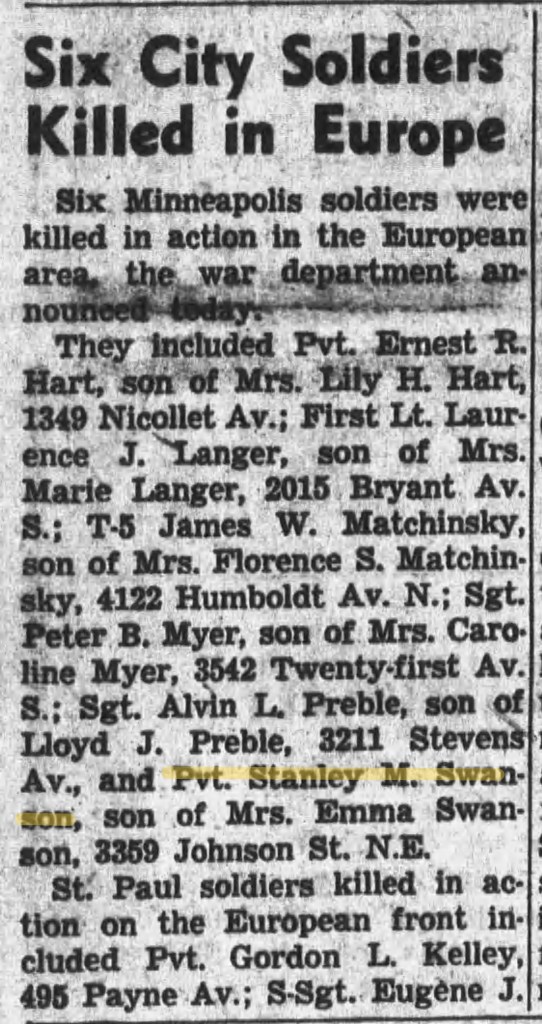
Stanley was originally buried at a temporary military cemetery in Aix-en-Provence, France.
In 1948 Stanley’s family chose to have his remains returned to Minnesota for reburial.
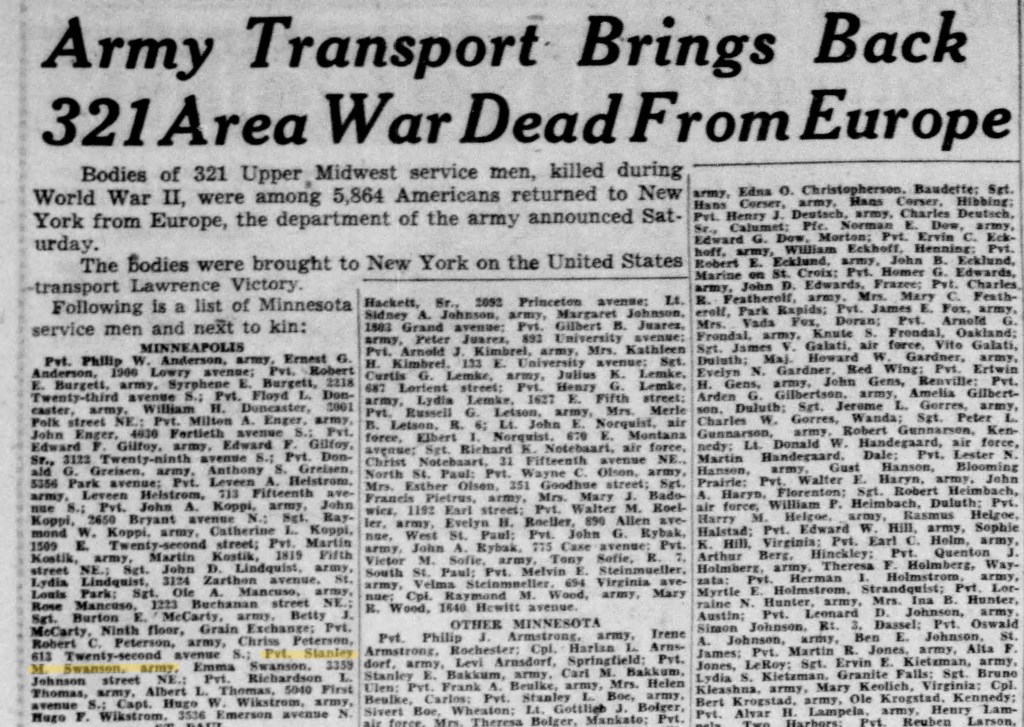
A reburial service for Stanley was held on 4Oct1948.
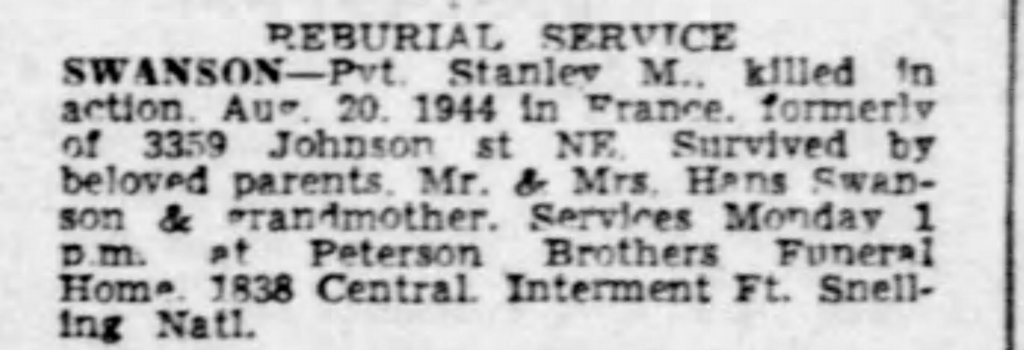
Stanley is buried at Fort Snelling National Cemetery in Minneapolis, Minnesota.