
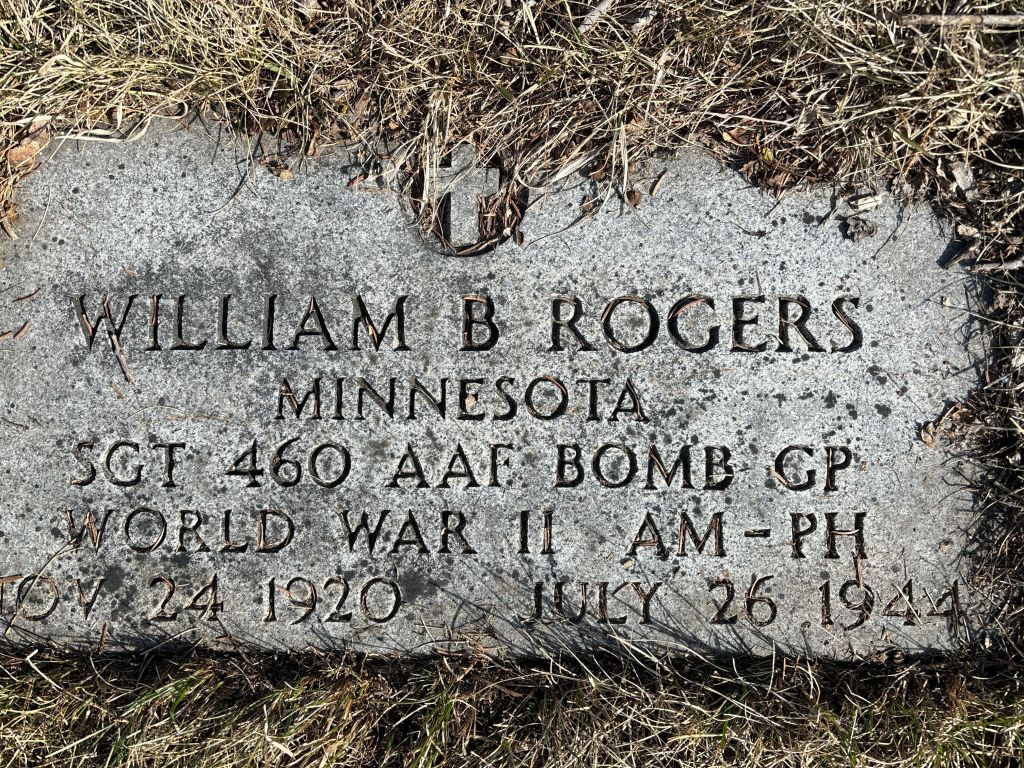
24Nov1920 – 26Jul1944
Edison Days
William’s (Buddy) name is included on the memorial plaque at Edison, and he is also featured in the “In Memoriam” section of the 1946 Wizard yearbook. It is unknown when he attended the school.
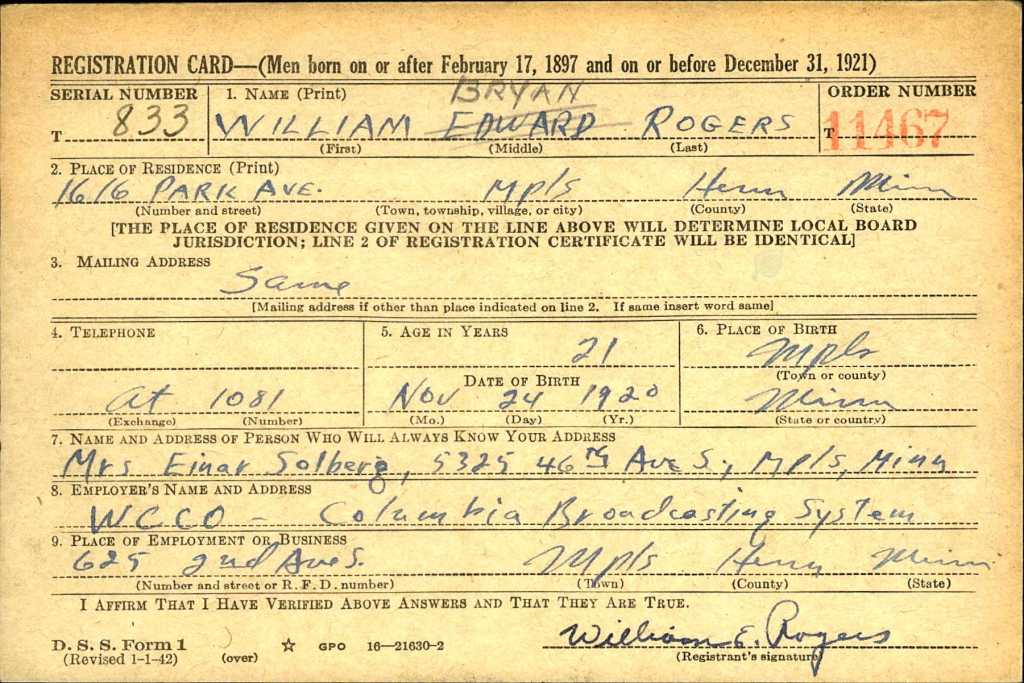
Military Service
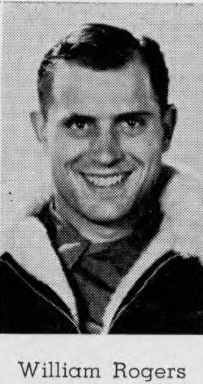

Rank: Sergeant
Branch: United States Army Air Corps
Unit: 762nd Bomb Squadron – 460th Bomb Group (Heavy) – 15th Air Force
Buddy was inducted into the Army on 4Sep1943. After basic training in Amarillo, Texas, and advanced training in Laredo, TX, he attended and graduated from aerial gunnery school in April 1944 at Peterson Field in Colorado.

In June 1944 he joined the crew of the B-24 bomber “Morning Star II” as a gunner flying out of Spinazzola Airfield in southern Italy.
Morning Star 2 flew on bombing missions to targets such as munitions plants in Germany, oil refineries/oil storage facilities in Austria, France, Poland, and Romania, and marshalling yards in Hungary.
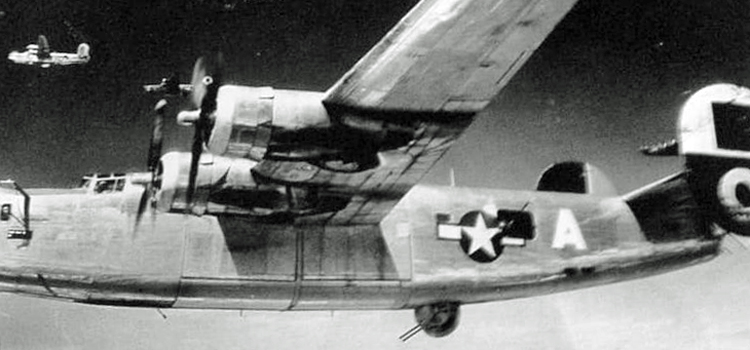
26Jul1944 would be Buddy’s 10th mission, and the last mission of the Morning Star II as 1 of 24 bombers sent to attack the Zwolfaxing Airdrome near Vienna, Austria.
From the official history of the 460th Bomb Squadron:
As the Group approached the target area, 10/10 clouds in two layers reached from 22 to 24,000’. It was necessary to drop below it for the bombing. Flak was extremely accurate, perhaps the most so in the experience of the 460th. As the lead box came out of the clouds to make the bomb run, No. 3 ship had become slightly separated from it. Flak guns lead this single ship, as though shooting skeet, and finally knocked it down. At this time a large projectile went through the left wing of the lead ship, leaving a hole a foot across but not causing a fire. Gas slopped out; gas ran into the bomb bay. Two engines cut out. Although it managed to maintain speed and altitude to drop on the target, this ship began to lose position immediately thereafter. Just as it seemed necessary to abandon the lead, the two engines again became operative through prompt transfer and saving of gas. The ship assumed its proper place in the Wing formation.
At 20,600’, 24 a/c dropped 59.5 tons of 1000 lb GP bombs, on the primary target, the Zwolfaxing A/D. RESULTS: Concentration of hits along hangar line in the two briefed aiming points. Many bombs fell short and over into adjacent field. Automatic pilots used by both first and second attack units. Due to malfunction, 1 a/c returned one bomb to this base.
16 a/c were damaged by flak. Eight crew members sustained minor wounds from the flak. Two members received head wounds, three leg wounds, one face, one head and one in the arm. 19 a/c returned to the base with a mean landing time of 1415 hours. Two a/c, seriously damaged by flak, landed at Vis, and another a/c landed at Gioia. In all, three a/c were lost to flak over the target, all of them going down in flames.
Buddy and the Morning Star II were 1 of the 3 planes brought down by flak.
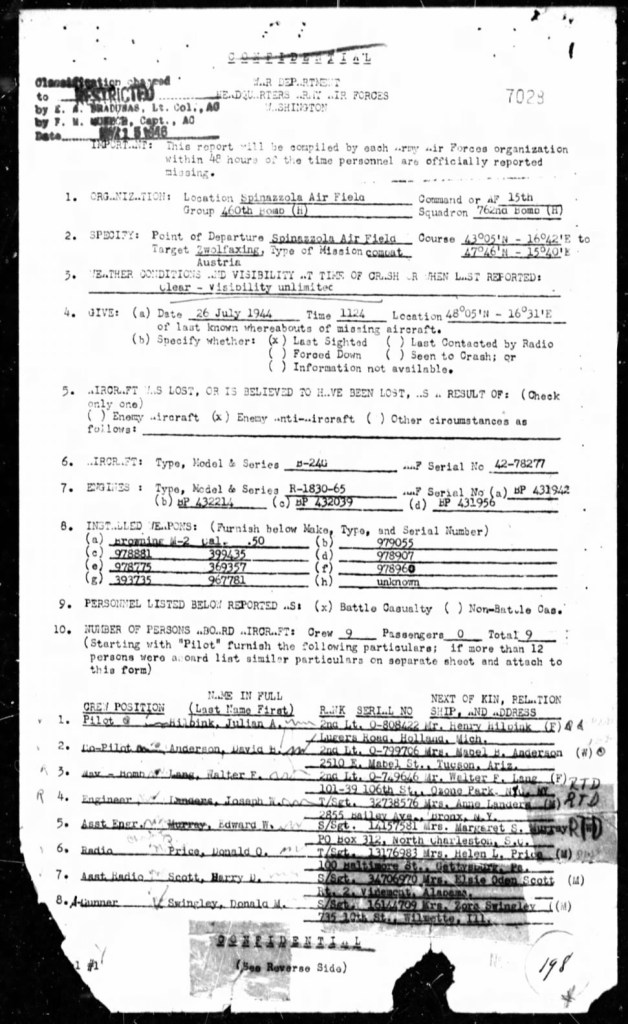
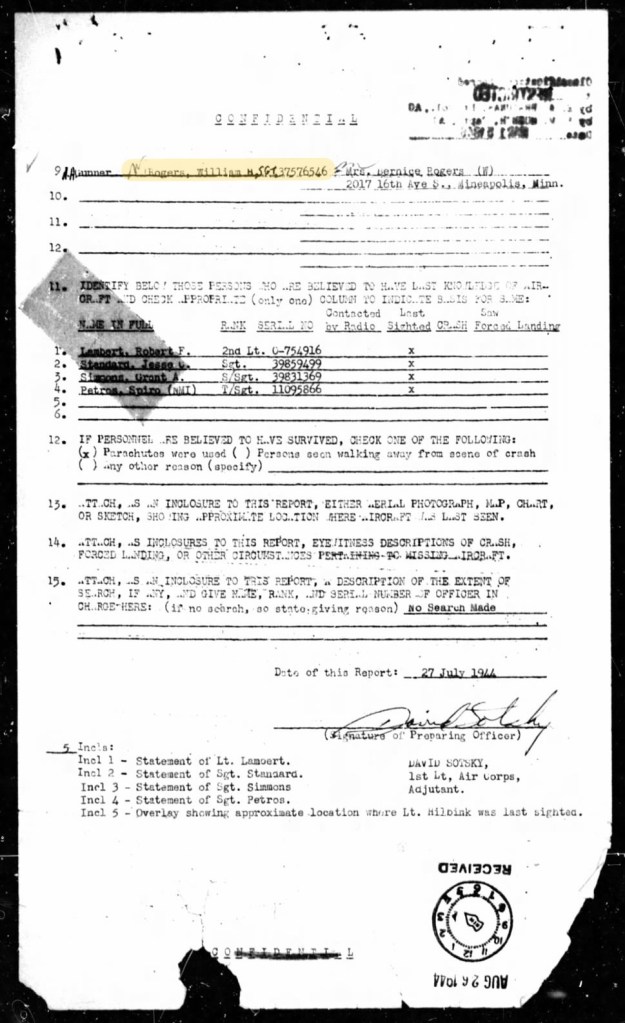
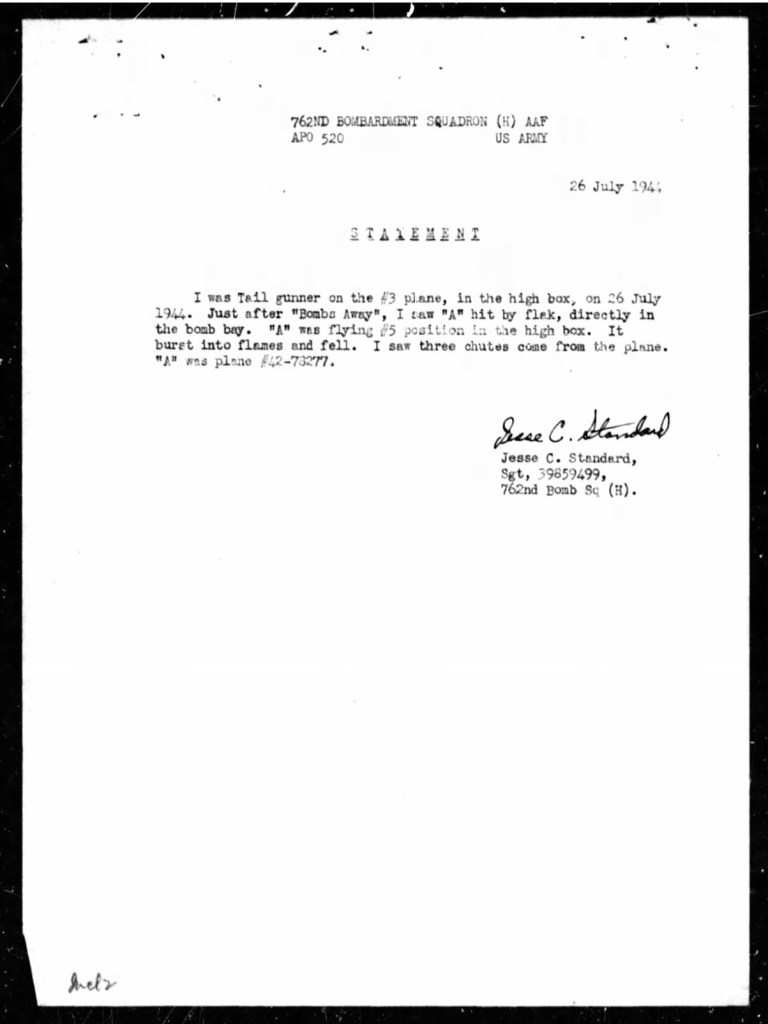
The planes navigator, engineer, and 1 of the gunners were able to escape the plane and parachute to the ground. They were captured and became prisoners of war.
Buddy and 5 of his crewmates went down with the plane. The German military recovered the remains of the crew and buried them near the crash site. They also filed a report on the crash.
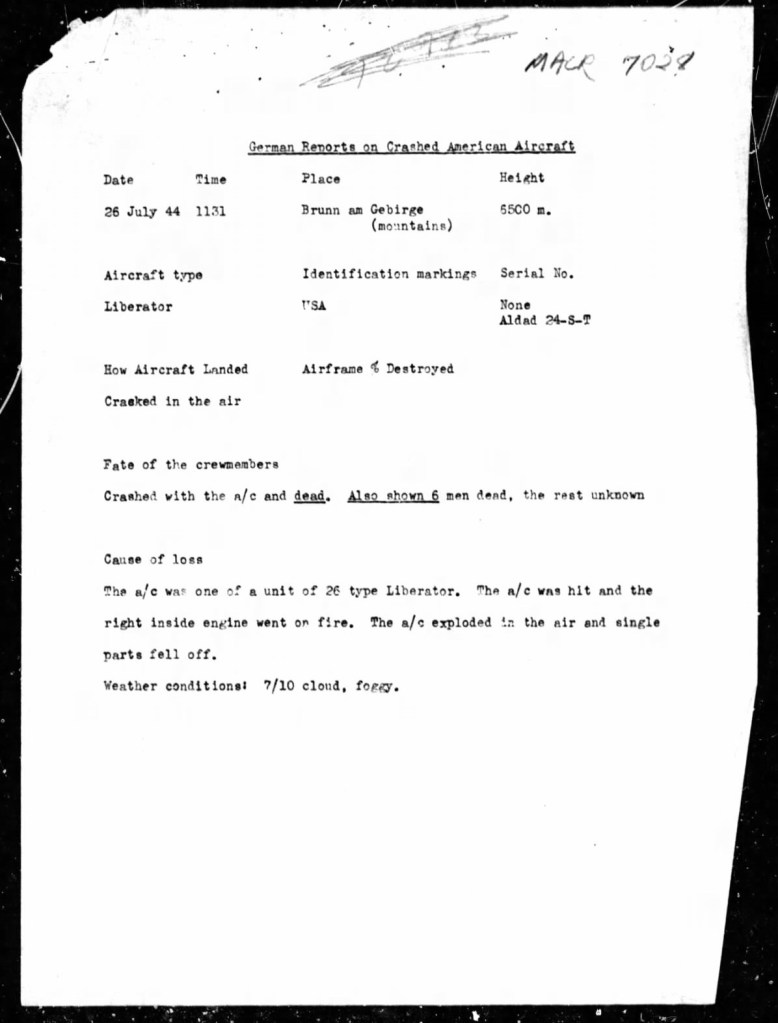
As the exact fate of the crew was unknown, Buddy’s family was informed that he was missing in action over Austria.
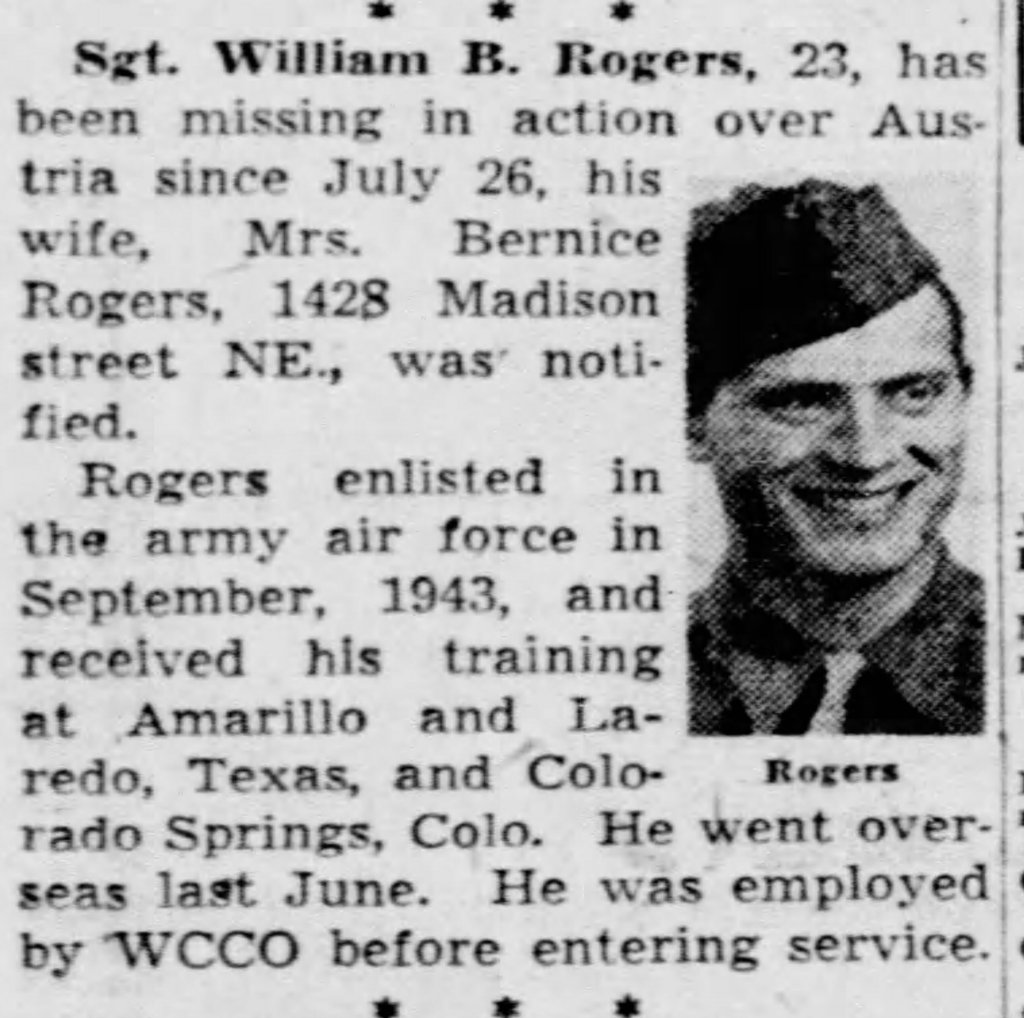
With no evidence that he was captured, or otherwise survived the shoot down of his plane, 1 year later Buddy’s status was changed to killed in action.
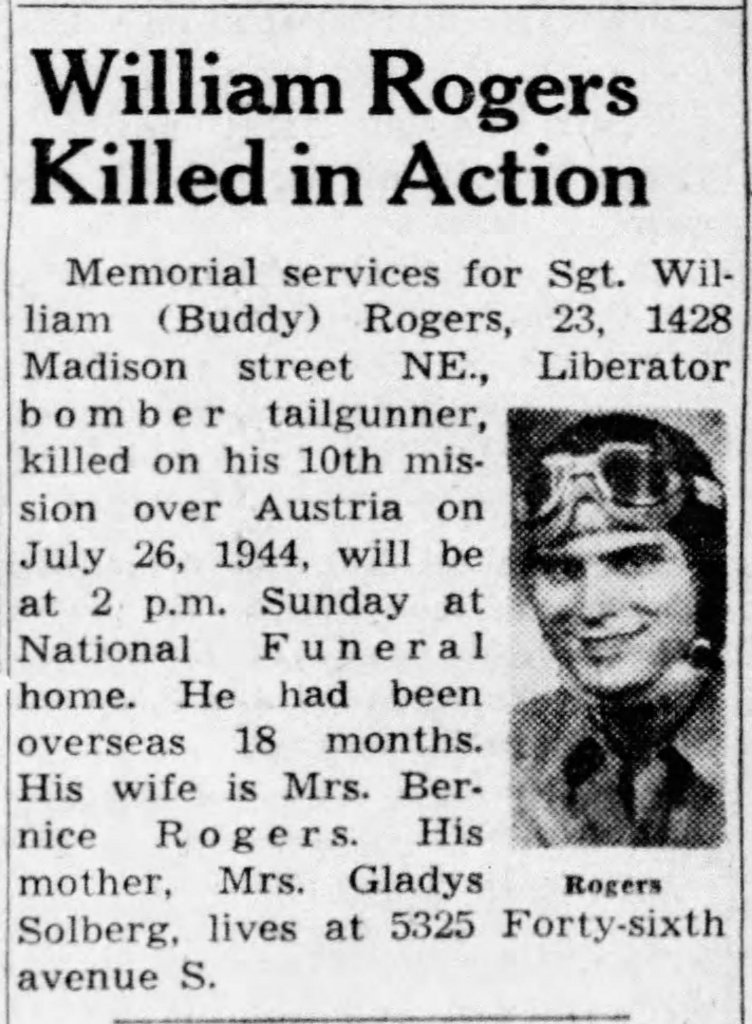
Buddy’s remains were discovered in 1946, and in 1949 they were returned to Minnesota for reburial.
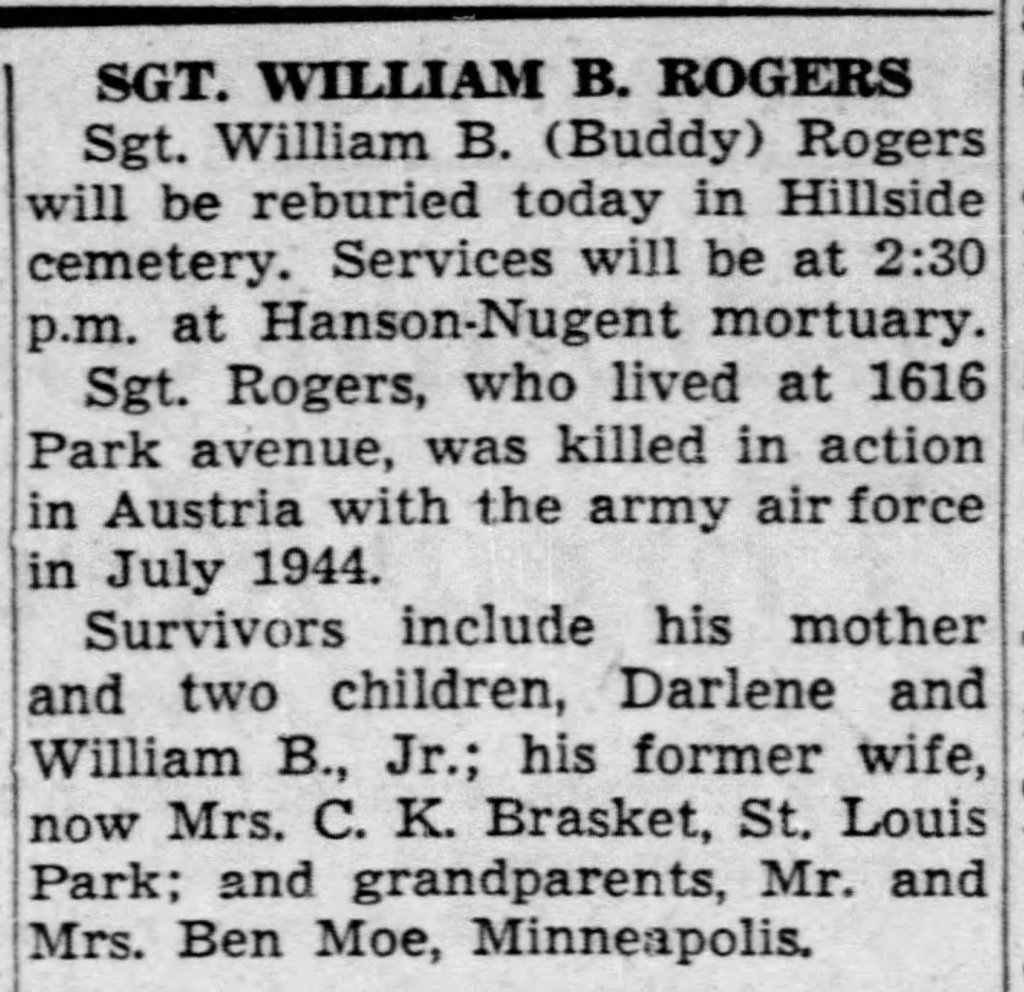
Buddy is buried at Hillside Cemetery in Minneapolis, Minnesota.
Despite the loss of 3 planes on the mission, due to the poor weather, the heaviest flak yet experienced, and the results of the bombing, the Army Air Force considered the mission to be a success. The 762nd Bomb Squadron would receive the Distinguished Unit Citation for their actions that day. Now called the Presidential Unit Citation, this is the highest award that can be awarded to a group.
The Presidential Unit Citation is awarded to units of the Uniformed services of the United States, and those of allied countries, for extraordinary heroism in action against an armed enemy on or after 7Dec1941, Pearl Harbor. The unit award is equal to the individual award of the Distinguished Service Cross, the U.S. military’s second-highest award for valor.
 Edison Heroes